Demographics
Immigrants are a vital, dynamic part of the U.S. population—especially when it comes to the workforce. 77.1% of immigrants are of working age (16–64), compared to just 62.0% of U.S.-born residents, making them key contributors to the economy as both taxpayers and consumers.
- 22.9 million immigrants are active in the U.S. workforce
- 74% of foreign-born residents are proficient in English
- 89.4% of all undocumented immigrants are of working age
- 5.2 million U.S. citizen children living with at least one undocumented family member
- Only 4.9% of immigrants are under 15, compared to 20.3% of U.S.-born residents
- 18% of immigrants are 65+, nearly identical to the 17.7% of U.S.-born seniors

ICE Scaling Back 287(g) Program
The 287(g) program has been controversial and criticized for years, and immigrant advocates have demanded that US Immigration and Customs Enforcement (ICE) terminate the program. Section 287(g) of the INA allows the Secretary of Homeland Security to enter into agreements that delegate immigration powers to local police, but only through negotiated agreements, documented in Memoranda of Agreement (MOAs). The task force model deputizes police to enforce immigration laws in the course of their regular activities on the streets, and the jail model places deputized police officers within jails. A recent development raises questions about the future of the program. Read More

A Growing Consensus on Supporting Immigration Reform
Immigration reform is not a “liberal” cause; it is a common-sense cause that appeals to people from a variety of political persuasions. More than a few conservative intellectuals, commentators, politicians, religious leaders, and law-enforcement officials favor revamping the U.S. immigration system to make it more responsive to the economic demands, social realities, and security concerns of the 21st century. This stance represents not only compassion, but enlightened self-interest. A growing body of evidence has quantified the enormous contributions that immigrants make to the U.S. economy through their labor, entrepreneurship, buying power, and innovation. Moreover, demographic trends point clearly to the growing electoral power of naturalized immigrants and to the native-born children of immigrants. In other words, being anti-immigrant in this day and age is self-destructive from both an economic and a political standpoint. Read More

Lifting Up Cities That Are Welcoming Immigrants
When it comes to immigration policymaking at the state and local level, all eyes have been focused for quite some time on train wrecks like Arizona and Alabama. These are places in which policymakers have chosen to deal with unauthorized immigration by embarking on a path of economic self-destruction—blindly lashing out at immigrants and Latinos no matter what the cost in terms of wasted taxpayer money, labor-force contraction, lost economic growth, community upheaval, and violations of fundamental human rights. Read More

Congress Pits One Form of Legal Immigration Against Another
We recently noted that the only point of agreement in the Republican and Democratic platforms on immigration was on the need for an infusion of green cards for STEM (science, technology, engineering, and math) graduates with advanced degrees from American colleges and universities. A recent poll conducted for the Partnership for a New American Economy and Compete America shows that 76 percent of Americans support the idea as well. If only Congress could draft legislation that simply sought to put that idea into practice. Read More

Immigrant Integration is a Two-Way Street
The process by which immigrants integrate into the economic and social fabric of the United States is very much a two-way street. Naturally, immigrants must harbor the desire to climb the socioeconomic ladder of success. But there must be a ladder for them to climb. If the community within which immigrants live and work makes the collective decision to deprive them of opportunities, then their upward mobility is hindered—to the social and economic detriment of the entire community. Yet, if the community actually welcomes newcomers and helps to facilitate their upward mobility, then the community eventually reaps the rewards of having workers and neighbors who are more highly skilled, more integrated, and more heavily invested in the community itself. Read More
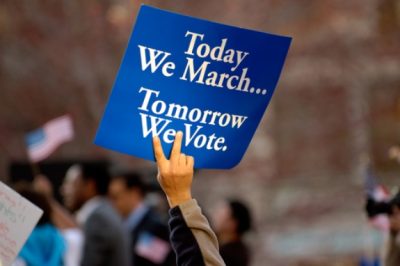
Nativist Group Trivializes the 2012 Latino Vote
The nativist Center for Immigration Studies (CIS) has an implicit message for the Republican Party heading into the 2012 elections: stop worrying about Latino voters and just play to your predominantly Anglo base. Such is the kamikaze message contained within a new CIS report, innocuously titled Projecting the 2012 Hispanic Vote. The report dismisses the claims of innumerable analysts that Latino voters could tip the electoral balance one way or the other in the so-called “battleground” states and, by extension, in the nation as a whole. After all, argues CIS, veterans and senior citizens outnumber Latinos in the national electorate, so why not focus on winning them over instead? This may seem comical to some observers, but CIS is saying it with a straight face. Read More

Nativist Group Publishes a Distorted Portrait of the Foreign-Born Population
The latest report from the Center for Immigration Studies (CIS), Immigrants in the United States, suffers from a bad case of selective statistics. While purporting to be a neutral and scholarly demographic profile of the foreign-born population in the United States, the report is actually an anti-immigrant treatise adorned with charts and bar graphs. On the one hand, the report lumps the native-born children of immigrants in with the immigrant population when tabulating rates of poverty, public-benefits usage, and lack of health insurance among the foreign-born. On the other hand, the report overlooks or minimizes the enormous economic contributions which immigrants make as consumers, entrepreneurs, and innovators. Reading the CIS report, you’d never know that immigrants pay taxes, create new jobs by opening businesses, or make scientific discoveries that transform entire industries. Read More

DHS’s NSEERS Program, While Inactive, Continues to Discriminate
For a long time after 9/11, immigration reform was only discussed as a national security issue, and many policies were put in place aimed at stopping terrorists from entering the country. Unfortunately, some of these policies—such as the National Security Entry-Exit Registration System (NSEERS) program—targeted particular ethnic groups, promoted profiling, and resulted in discrimination and civil rights violations. In recent years, the Obama administration has made efforts to end the NSEERS program, but NSEERS still exists and the impact of these policies is still being felt in immigrant communities. In fact, the Rights Working Group, a coalition of civil rights organizations, recently released a report, The NSEERS Effect: A Decade of Racial Profiling, Fear, and Secrecy, which analyzes the continuing impact of this post-9/11 policy. Read More

New Data Reveals Immigrants’ Voting Potential at the Local Level
Newly obtained data from the DHS Office of Immigration Statistics provide another indication that immigrants in the United States hold untapped electoral power. There are 8.1 million legal immigrants who arrived in this country between 1985 and 2005 and who are likely eligible to become naturalized U.S. citizens with the power to vote. If these immigrants were already U.S. citizens, and if they registered to vote at the same rate as other naturalized citizens (61%), counties across the nation would see their voter registration rolls jump dramatically. Read More

Lawmakers Attempt to Gut Census by Defunding American Community Survey
How can you make good policy in the absence of good information? That seems to be a question that some Republicans in the House and Senate have not asked themselves. In recent months, these lawmakers have proposed that funding for the Census Bureau’s annual American Community Survey (ACS) be cut entirely from the federal budget, or that the ACS be scaled back to a “voluntary” program. Given that the data generated by the ACS is used to guide the distribution of more than $400 billion in federal funding each year, this would be an ill-advised move. Read More
All gifts are matched dollar for dollar
No one should face the immigration system alone