Integration
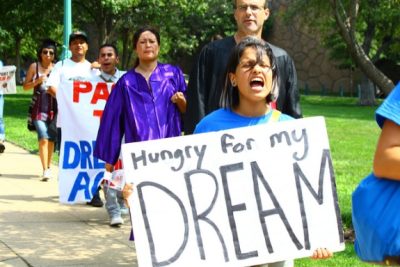
What’s the Value of Keeping Undocumented Youth in the Shadows?
The real life psychological ramifications of young immigrants struggling with their unauthorized status are often glossed over in the larger immigration debate. In a recent journal article, Learning to Be Illegal: Undocumented Youth and Shifting Legal Contexts in the Transition to Adulthood, University of Chicago professor Roberto G. Gonzales uses 150 interviews with young Latino adults to examine how unauthorized youth deal with their legal status as they come of age. Gonzales finds that as unauthorized immigrant children transition into adulthood, many “learn to be illegal,” figuring out how to exist in a society that was once welcoming, but now prohibits their participation. Read More

Immigration Group Honors Winner of National 5th Grade Writing Contest
Tonight, the American Immigration Council will honor Maya Young Wong, the winner of the 14th Annual “Celebrate America” Creative Writing Contest, at the 2011 American Heritage Awards in San Diego. Maya Young Wong of California will read her winning poem, “My Grandfather Ben,” which was selected out of more than 6,500 entries by a host of celebrity judges, including Olympic Gold Medalist in wrestling, Henry Cejudo; the President of the America Federation for Teachers, Randi Weingarten; Presidential Medal of Freedom recipient and Holocaust survior, Gerda Weissman Klein; and President pro tem Senator Dan Inouye of Hawaii. Read More

More Immigrants are Educated, Skilled Than Ever Before, Report Finds
A new report released by the Brookings Institution dispels the myth that all immigrants are unskilled, uneducated, and illegal. The report, entitled The Geography of Immigrant Skills: Educational Profiles of Metropolitan Areas, finds that the share of working-age immigrants in the United States who have at least a bachelor’s degree is greater than the share who lack a high-school diploma. Moreover, immigrants with college degrees outnumber immigrants without high-school diplomas by wide margins in more than two-fifths of the nation’s 100 largest metropolitan areas. Read More

How U.S. Integration Policies Stack up Against Other Countries
Today, immigration policy analysts discussed the Migrant Integration Policy Index (MIPEX)—a survey which measures the immigration and integration policies of 31 nations—as well as the survey’s implications for integration policy in the U.S. Overall, the U.S ranked 9th out of the 31 countries surveyed, but first in terms of its strong anti-discrimination laws and protections. Compared with other countries, legal immigrants in the U.S. enjoy employment opportunities, educational opportunities, and the opportunity to reunite with close family members. However, MIPEX also acknowledges that the U.S.’s complex immigration laws, limited visa availability, high fees, and long backlogs may make it challenging for immigrants to integrate into the fabric of American life—a challenge best tackled by comprehensive reform. Read More

By the Numbers: How the FY 2011 Budget Impacts Immigration
After the threat of a government shutdown last week, Congress finally managed to approve a budget that will keep the government running through the 2011 fiscal year. Included in that budget, however, are a host of cuts that will impact immigrants and immigration programming in the fiscal year to come. As policy experts and economists continue to pour over the 175 page document, here are a few program areas impacted by the FY 2011 budget. Read More

Restrictionist Group Blames the Children of Immigrants for America’s Budget Woes
The Center for Immigration Studies (CIS) released another report today attempting to blame our economic woes and budget shortfalls on immigrants—this time using the children of immigrants, most of whom are U.S. citizens, as scapegoats for benefits usage (here Medicaid, food assistance, cash assistance, and housing programs). As are most restrictionists’ attempts to blame immigrants for all of America’s problems, the report is rife with methodological problems. Despite the headline that 57 percent of households headed by an immigrant with children used at least one benefits program, compared to 39 percent for native households, the results actually show that when controlled for income, immigrant households use benefits at the same rate as native born households. Read More

Why Cutting Immigrant Integration Programs Hurts All of Us
Among the many spending cuts recently passed by the House was funding for the Office of Citizenship’s immigrant integration programs. The importance of these programs, however, cannot be overstated. Immigrants who integrate into U.S. society go on to become innovators, entrepreneurs and future job-creators. Although a new study released today by the British Council, Migration Policy Group and Immigration Policy Center ranks the U.S. nine among 31 countries in promoting full integration of legal residents (a relatively good score), cutting these programs can only hurt us in the long run. As the Senate prepares to take up the Continuing Resolution, restoring $11 million to the budget of the Office of Citizenship should be a no brainer given that this relatively small investment in the potential of aspiring Americans can pay huge dividends for the United States. Read More

New Study on Immigrant Integration Compares and Ranks the United States, Canada, and Europe
Washington D.C. – In cooperation with the Immigration Policy Center, the British Council and the Migration Policy Group release a new study today which reviews and ranks U.S. immigrant integration policies against other countries. The Migrant Integration Policy Index (MIPEX: www.mipex.eu) contrasts and compares integration policies for legal immigrants… Read More
President’s 2012 Budget Reveals Conflicted Priorities on Immigration
The President’s proposed FY 2012 budget for the Department of Homeland Security (DHS) illustrates the Obama administration’s conflicted priorities when it comes to immigration. On the one hand, the budget increases funding for worthy causes such as immigrant integration, alternatives to detention, and civil-liberties oversight of enforcement programs. On the other hand, these funding increases are dwarfed by the size of the budget for border and interior immigration enforcement. In other words, despite some good intentions, and an effort to balance the impact of enforcement programs, ultimately the budget reflects a commitment to the enforcement-without-reform policies that have failed so miserably over the past two decades. Read More
“100,000 Strong” Initiative Strengthens U.S.-China Relations, But Does It Go Far Enough?
Chinese President Hu Jintao’s State Visit put all eyes on Washington, D.C. last week. While much of the political buzz focused on human rights, trade and the economy, President Hu’s visit stood out in its effort to show mutual cross cultural respect. Part of that ongoing effort is the “100,000 Strong” initiative—a program Secretary of State Hilary Clinton officially launched in 2010 in Beijing to “increase dramatically the number and diversify the composition of American students studying in China. Also last week, First Lady Michelle Obama announced $2.25 million in private sector funding to support the initiative and urged thousands of Washington, D.C. youth to “study in China, work together and make America and the world stronger.” However, while the “100,000 Strong” initiative certainly facilitates a deeper cultural understanding, does it go far enough in providing opportunities for a deeper understanding of foreign business practices? Read More
All gifts are matched dollar for dollar up to $75,000
No one should face the immigration system alone