 The American Immigration Council is a non-profit, non-partisan organization.
 The Illinois Accountability Commission, the first state effort to investigate federal immigration enforcement misconduct, recently released its long-awaited report that creates a public record of the actions taken by federal immigration agents during Operation Midway Blitz. The operation saw thousands of federal agents target the Chicago area in late 2025 with indiscriminate immigration enforcement. The commission’s robust and historic state effort documents how federal officers terrorized Chicago residents throughout this operation. The findings directly challenge the federal government’s claims that immigration agents were focused on addressing public safety threats.
The commission also found that federal actors misled the public, used unwarranted and unlawful force, denied due process, and caused profound harm to families across greater Chicago.
What is the Illinois Accountability Commission?
Between September and December 2025, federal officers from U.S. Immigration and Customs Enforcement (ICE), U.S. Customs and Border Protection (CBP), and other federal agencies conducted immigration raids in the Chicago area under what they dubbed “Operation Midway Blitz.” State and local officials, business, civic, and faith leaders, and the general public vocally opposed the operation.
Responding to a lack of transparency from the federal government about the operation’s scope, actions, and impact, Illinois Governor JB Pritzker established an independent board — the Illinois Accountability Commission — in October 2025 to “show the public exactly what is going on.” The governor tasked the commission with investigating the conduct of federal law enforcement during Operation Midway Blitz, documenting its impact on the public, and providing recommendations to avoid future harms.
What were the commission’s findings?
Informed by months of public hearings, community listening sessions, and independent investigations, the commission pieced together a detailed picture of the events of Operation Midway Blitz, one that contradicts federal officials’ public statements.
Key findings include:
Roving Patrols Resulted in Discriminatory Arrests, Not Targeted Enforcement
Federal officials claimed: Operation Midway Blitz will target the worst of the worst criminal undocumented immigrants in Chicago.
The commission found: Of the estimated 3,900 individuals arrested and detained during this period, 85% had no criminal convictions. In fact, the share who had criminal convictions was smaller during the operation than at any other period going back to January 2024.
Federal officials did not prioritize targeted enforcement as part of Operation Midway Blitz. Instead, roving patrols of federal officers flooded Chicago streets, arresting people based solely on their race or language spoken.
Federal Officers Frequently Used Excessive Force
Federal officials claimed: Federal agents’ use of force in Chicago has been more than exemplary.
The commission found: Federal officers engaged in “unjustified and excessive” use of force that violated agency policies, federal and state law, and individuals’ constitutional rights – in numerous and likely undercounted instances. Chemical weapons were used on over 60 separate occasions and often indiscriminately, though Chicago area protests remained largely peaceful. ICE and CBP agents also used intimidation tactics to suppress individuals’ First Amendment rights, including by surveilling and physically assaulting protesters and observers.
Paramilitary Tactics Used by Federal Officials Disrupted and Harmed Community Well-Being
Federal officials claimed: A federal crackdown in Chicago will make the city very safe.
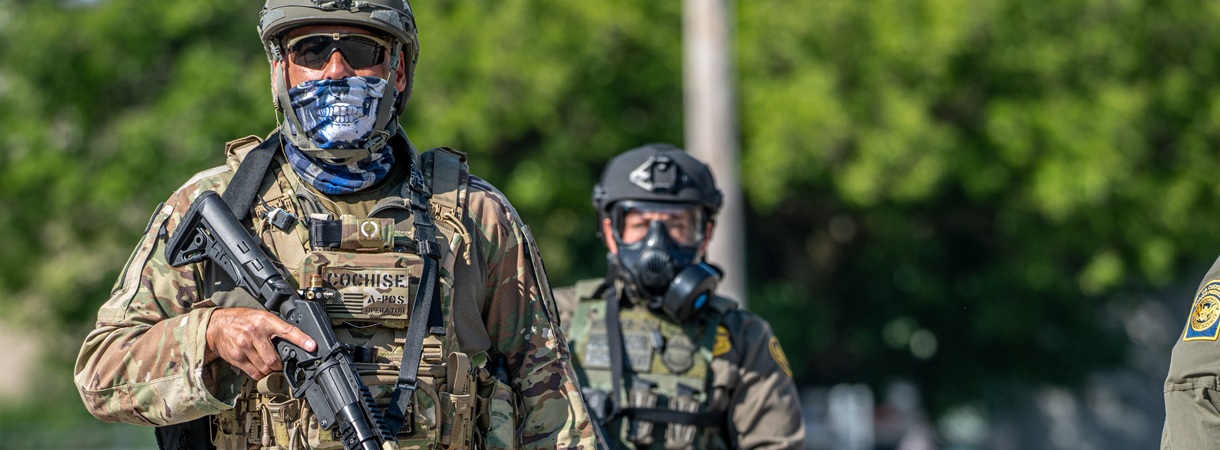
The commission found: Federal agents utilized military-style tactics and equipment that included wearing masks, concealing identification, using unmarked vehicles, and conducting heavily armed raids with media tagging along. This resulted in over 500 destabilizing actions initiated by federal actors, like questionable arrests, abuse of policing power, and intrusion into homes or property. Former Border Patrol Commander-at-Large Gregory Bovino summed up the federal approach to this operation in saying: “We are going to turn and burn and we’re gonna go throughout Chicago with reckless abandon.”
These actions reverberated widely across all corners of greater Chicago. The commission documented widespread harms to residents’ physical and mental health, education, economic stability, and community trust. Federal officers’ discriminatory practices and actions caused fear across communities — impacting both immigrant and citizen residents. Enforcement actions near sensitive locations like schools and hospitals exacerbated these impacts, as fear and distress led community members to miss classes, doctors appointments, and work.
What’s next?
This report is an attempt at providing transparency, documenting the experiences of individual Illinoisans that the federal government misrepresented or concealed. The commission’s findings underscore the deep harms caused by indiscriminate and disproportionately violent immigration enforcement. Because the federal government has failed to ensure meaningful accountability for its officers or cooperate with state and local misconduct investigations elsewhere in the country, this approach could provide a model for other states like Minnesota to pursue similar accountability efforts.
The report also offers a way forward — offering recommendations to rebuild community trust and help ensure such harms are not inflicted on U.S. communities in the future.