
With at least 42 states under stay-at-home orders due to the coronavirus outbreak, the U.S. food sector is under an unprecedented test to feed hundreds of millions of Americans amid a pandemic. While the food supply chain is facing severe disruptions in areas ranging from production to transportation to distribution, data from the U.S. Census Bureau shows that immigrants play a vital role in helping the food sector adapt to these new challenges.
Overall, 3.8 million immigrants make up more than one in five workers in the U.S. food sector. They are among the essential workers who leave the safety of their homes to handpick fresh vegetables and fruits, process meat and seafood, stock shelves with groceries, and deliver food to people’s doorsteps.
Figure 1: Immigrant Workers in the U.S. Food Sector Source: NAE Analysis of 1-year sample from the 2018 American Community Survey
Number of Foreign-born Workers
Share of All Workers, Foreign-born
Food Sector, Overall
3,806,511
21.6%
Agriculture
546,383
27.6%
Food Processing
500,085
28.7%
Food Wholesale Trade
212,048
24.4%
Grocery Stores and Supermarkets
528,811
16.6%
Restaurants and Food Service
2,019,184
20.5%
In the states hard hit by the coronavirus, immigrant food workers are particularly important to help keep America’s food supply chain running and ensure people can still get the food they need in this time of crisis. In New York and New Jersey, the states with the most Covid-19 cases in the country as of mid-April, at least one in three food workers are foreign-born.
Figure 2: Immigrant Workers in the U.S. Food Sector Source: NAE Analysis of 1-year sample from the 2018 American Community Survey
State
Number of Foreign-born Workers
Share of All Workers, Foreign-born
New York
325,972
35.5%
New Jersey
135,932
34.4%
California
980,038
42.5%
Michigan
51,691
10.2%
Massachusetts
92,473
26.9%
Florida
310,152
27.9%
Illinois
150,384
21.8%
Washington
126,331
27.7%
Pennsylvania
76,719
11.6%
Texas
395,888
26.6%
Virginia
72,228
18.3%
Georgia
91,260
16.2%
Arizona
78,930
22.3%
Maryland
66,522
25.3%
North Carolina
82,311
13.9%
Across the country, farmers and ranchers are committed to providing Americans with safe, affordable food. However, already facing a labor shortage before the outbreak, the agriculture sector relies on immigrant workers to fill the gaps. In 2018, about 27.6 percent of all agricultural workers in the United States were immigrants. In some states, that share is even higher. For example, in California, the country’s top agricultural state, immigrants made up almost two-thirds of the agricultural workforce.
More than ever, the country needs more immigrant workers to manage the disruptions to the agriculture industry. To address the labor challenge due to travel restrictions related to Covid-19, the Homeland Security Department just announced a temporary final rule to allow U.S. farms to employ H-2A workers who are already in the country and these temporary workers to stay beyond three years, their maximum length of stay in the country.
Figure 3: Immigrant Workers in the Agriculture Industry Source: NAE Analysis of 1-year sample from the 2018 American Community Survey
Number of Foreign-born Workers
Share of All Workers, Foreign-born
United States
546,383
27.6%
California
256,362
64.7%
Washington
47,664
50.7%
Florida
37,506
43.8%
Texas
31,526
28.7%
North Carolina
15,545
24.8%
Arizona
11,223
44.0%
In the next two months, as key vegetables and fruits come into season, farms will increasingly need immigrant workers to take on jobs that are often physically taxing or require specialized skills. Nationwide, immigrants make up close to half of all field workers in the agriculture industry. Their hard work helps ensure farms can harvest the highly perishable products at the right time quickly and fill the grocery store shelves for Americans looking for healthy food.
Figure 4: Select Occupations in the Agriculture Industry in the United States Source: NAE Analysis of 1-year sample from the 2018 American Community Survey
Occupation
Number of Immigrant Workers
Immigrants’ Share of Workforce
Field Workers
372,691
48.6%
Graders and Sorters
13,931
62.7%
Hand Packers and Packagers
10,846
73.8%
In the food processing industry, immigrants also play a critical role in meeting America’s growing appetite for diverse foods. Nationwide, immigrants make up 28.7 percent of all workers in the food processing industry. In California, New Jersey, and Florida, more than 40 percent of their food processing workforce are immigrants.
Figure 5: Immigrant Workers in the Food Processing Industry Source: NAE Analysis of 1-year sample from the 2018 American Community Survey
Number of Foreign-born Workers
Share of All Workers, Foreign-born
United States
500,085
28.7%
New York
19,260
31.5%
New Jersey
19,148
48.2%
California
96,187
51.1%
Florida
19,479
43.7%
Illinois
27,975
29.1%
Washington
15,233
33.8%
Pennsylvania
15,701
19.2%
Looking at specific occupations, immigrants make up more than half of hand packers and packagers, almost half of meat processing workers, and two in five other food processing workers. But as the coronavirus spreads, they are also becoming increasingly vulnerable, facing significant health risks at work.
Several meatpacking companies have already fallen victim to the coronavirus, including Smithfield Foods, the world’s largest pork producer. It has closed its meatpacking plant in Sioux Falls, South Dakota, indefinitely, after more than 200 of its workers there became confirmed cases for Covid-19. The food processing industry is struggling with the daunting challenge of preventing a potential food shortage while keeping their workers healthy and safe.
Figure 6: Select Occupations in the Food Processing Industry in the United States Source: NAE Analysis of 1-year sample from the 2018 American Community Survey
Occupation
Number of Immigrant Workers
Immigrants’ Share of Workforce
Packaging and Filling Machine Operators and Tenders
69,115
44.4%
Other Food Processing Workers
52,054
40.6%
Butchers and Other Meat Processing Workers
39,408
49.1%
Bakers
37,602
37.4%
Hand Packers and Packagers
33,592
53.6%
Food Batchmakers
13,125
28.9%
With mass closures of restaurants and schools, both farms and food processors are shifting their distribution priorities from wholesale food-service markets to retail grocery stores with surging demand, where immigrant workers are integral to their daily operations. While more than 212,000 immigrants work in food wholesale trade, nearly 529,000 immigrants are employed in groceries and supermarkets across the country, making up 16.6 percent of the workforce.
Figure 7: Immigrant Workers in Grocery Stores and Supermarkets Source: NAE Analysis of 1-year sample from the 2018 American Community Survey
Number of Foreign-born Workers
Share of All Workers, Foreign-born
United States
528,811
16.6%
New York
61,577
31.0%
New Jersey
23,564
25.4%
California
120,287
33.7%
Massachusetts
18,343
21.0%
Florida
60,194
25.4%
Illinois
21,792
19.8%
Washington
11,115
15.1%
In grocery stores and supermarkets, immigrants share responsibilities with their U.S.-born colleagues to make sure customers get the food they need as much as possible. They make up one in seven cashiers, one in eight stockers and order fillers, more than 30 percent of all janitors and building cleaners, and one in five delivery workers. Millions of Americans now count on them to secure enough food for their families who mostly eat at home these days.
However, like workers in meatpacking factories, grocery workers are also facing a heightened risk of infection, due to the nature of their work being in close contact with the public at their workplace. Unfortunately, several grocery stores and supermarkets have already reported deaths among their employees due to Covid-19.
Figure 8: Select Occupations in Groceries and Supermarkets in the United States Source: NAE Analysis of 1-year sample from the 2018 American Community Survey
Occupation
Number of Immigrant Workers
Immigrants’ Share of Workforce
Cashiers
122,729
15.3%
Stockers and Order Fillers
48,000
13.4%
Laborers and Material Movers
41,672
13.6%
Retail Salespersons
28,246
23.7%
Janitors and Building Cleaners
11,767
30.7%
Delivery Workers
7,939
20.0%
Although many restaurants are closed or struggling to remain open, the food service industry is still meeting the demand from people ordering take-outs and delivery of meals and groceries from home. About 2 million immigrants work in this sector, making up one-fifth of its workforce in the country.
Figure 9: Immigrant Workers in Restaurants and Food Service Source: NAE Analysis of 1-year sample from the 2018 American Community Survey
Number of Foreign-born Workers
Share of All Workers, Foreign-born
United States
2,019,184
20.5%
New York
221,478
39.4%
New Jersey
75,394
34.6%
California
441,023
35.9%
Michigan
30,540
9.4%
Massachusetts
57,955
28.2%
Florida
177,842
25.6%
Illinois
89,460
22.9%
Washington
44,581
20.5%
Pennsylvania
37,437
11.0%
Among the major occupations in the restaurants and food service industry, immigrants make up almost one in three chefs and cooks, one in five food service managers and food preparation workers, one in nine fast food and counter workers, and one in six cashiers and delivery workers.
However, many immigrant workers in the food service industry face economic hardships since the sector is among the ones that have been hit the hardest by the Covid-19 outbreak and the subsequent social distancing measures. For example, since many restaurants can no longer offer dine-in services, waiters and waitresses, including 338,000 immigrant workers, have lost their jobs or are struggling to keep their current ones. In March, the country lost 417,000 jobs at restaurants and bars and may experience even more substantial cuts in April.
Figure 10: Select Occupations in Restaurants and Food Service in the United States Source: NAE Analysis of 1-year sample from the 2018 American Community Survey
Occupation
Number of Immigrant Workers
Immigrants’ Share of Workforce
Chefs and Cooks
646,472
31.0%
Waiters and Waitresses
338,193
16.5%
Food Service Managers
200,564
21.5%
Food Preparation Workers
159,967
21.1%
Cashiers
149,004
18.0%
Fast Food and Counter Workers
47,599
11.8%
Delivery Workers
45,898
18.2%
During this severe public health—and now economic—crisis, immigrants are working on the front lines and behind the scenes along the food supply chain to help provide Americans with the food they need, often at their doorsteps. As the pandemic upends life in the country, Yassin Terou, a Syrian refugee who runs two falafel shops in Knoxville, Tennessee, shares his lessons about how to be resilient in crisis and find a pathway forward. So far, his business has managed to stay afloat in the past few weeks, and he hasn’t had to lay off any of his 30 employees.
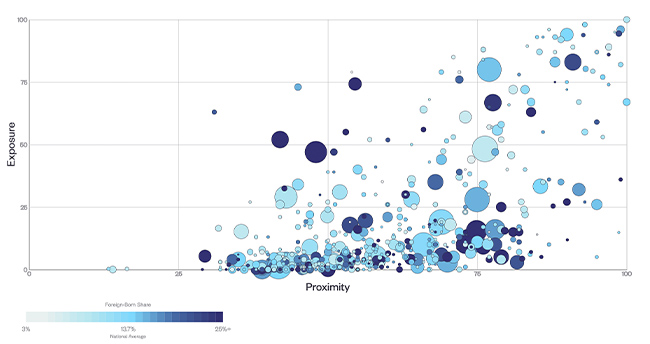
If you want to explore how immigrants often disproportionately serve in some of the most at-risk jobs in the Covid-19 crisis, including the food-sector jobs featured in this brief, click the image below to explore our data visualization.
Finally, check out our research portal of Immigration and Covid-19. If you have any specific questions about our data, please reach out to us at [email protected].