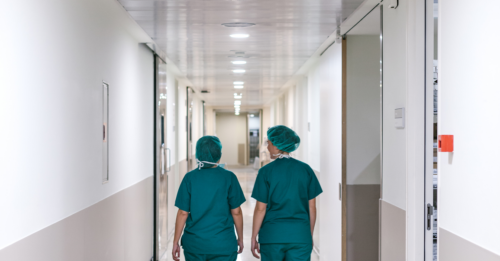
The United States is facing the most dire healthcare crisis in recent memory. Last week, NAE took a look at the role immigrants are playing in the fight against the coronavirus outbreak as healthcare workers and in supporting industries. Today, we examine the most vulnerable group of immigrants, the undocumented. The data reveals that undocumented immigrants too are serving in critical frontline healthcare roles as support workers as well as in industries that are keeping the rest of the U.S. economy functioning as best as it can during this time.
In 2018, there were almost 280,000 undocumented workers in the healthcare industry, including 62,600 DACA-eligible individuals.
Top 10 States for Undocumented Healthcare Workers, 2018 Source: NAE Analysis of 2018 ACS Microdata, 1-year Sample, downloaded from IPUMS-USA.
State
Number of Undocumented Healthcare Workers
California
56,000
Texas
41,800
New York
40,100
Florida
21,700
Illinois
15,000
New Jersey
13,600
Massachusetts
7,000
Maryland
7,000
Pennsylvania
6,400
Virginia
6,300
While barred from most higher skilled medical and healthcare professions, the data shows that undocumented immigrants play a vital role as healthcare support workers, working as nursing assistants, as health aides, as well as the cleaners and building maintenance workers that keep medical and care facilities running.
Top Occupations for Undocumented Healthcare Workers, 2018
Occupation
Number of Undocumented Workers
Undocumented Share of All Workers
Nursing Assistants
44,748
3.7%
Home Health Aides
29,697
6.9%
Personal Care Aides
25,688
4.4%
Medical Assistants
18,657
3.6%
Housekeepers and Cleaners
15,579
6.4%
Receptionists and Information Clerks
10,932
2.4%
Dental Assistants
9,110
3.1%
Registered Nurses
6,630
0.2%
Janitors and Building Cleaners
5,483
4.1%
Cooks
5,389
4.9%
We find that DACA-eligible immigrants, many of whom are allowed to work in higher skilled medical and health professions under the DACA program, are well represented in healthcare as registered nurses and medical assistants.
Outside the healthcare industry, undocumented immigrant workers often work in industries that are likely to be severely impacted by the economic fallout of the Covid-19 crisis. In particular, hotels and restaurants, which are already feeling the negative effects of shelter-in-place rules and declines in travel and food consumption, have high shares of undocumented workers.
Undocumented Workers in Adversely Affected Industries Source: 2018 American Community Survey
Industry
Number of Undocumented Workers
Undocumented Share of All Workers
Hotels and Accommodation
152,925
10.0%
Restaurants and Food Service
812,190
8.3%
Despite this, many undocumented immigrants also work in roles deemed “essential” from grocery store workers to auto repair mechanics. Delivery people have proven indispensable in getting food, medicines, and other supplies to people stuck at home. In New York, the epicenter of the outbreak in the United States, undocumented immigrants form an even more significant share of the delivery workforce, with almost 1 in 3 food delivery people being undocumented.
Spotlight on Undocumented Delivery People Source: 2018 American Community Survey
Essential Industry
Number of Undocumented Delivery People, Nationwide
Undocumented Share of Delivery People, Nationwide
Number of Undocumented Delivery People, New York State
Undocumented Share of Delivery People, New York State
Groceries and Supermarkets
9,870
6.8%
2,000
15.0%
Restaurants and Food Service
15,153
6.0%
6,453
32.6%