The Fourteenth Amendment to the United States Constitution guarantees birthright citizenship to every child born “within the jurisdiction of the United States.”1 The 1898 Supreme Court case of United States v. Wong Kim Ark established an important precedent in its interpretation of the Citizenship Clause of the Fourteenth Amendment in that it cemented birthright citizenship for children of all immigrants. For over a century, anyone born on U.S. soil has automatically been conferred citizenship at birth regardless of their parents’ immigration or citizenship status. While most legal scholars across the political spectrum have maintained that the Fourteenth Amendment interpreted through Wong Kim Ark unequivocally extends birthright citizenship to anyone born in the United States, anti-immigrant political factions have pushed to restrict birthright citizenship—primarily, attempting to deny it to children born in the United States to undocumented immigrant parents. On January 20, 2025, one of President Trump’s first actions after being inaugurated was to issue an executive order purporting to deny birthright citizenship to children born of undocumented parents or whose parents are in the country on temporary status. However, on June 30, 2026, the U.S. Supreme Court held that the Trump administration’s executive order was unconstitutional, and that he could not end birthright citizenship through an executive order.
This Fact Sheet Explains:
- What Is Birthright Citizenship?
- The Fourteenth Amendment and Its Interpretations.
- Who is Eligible for Birthright Citizenship?
- Can Birthright Citizenship Be Taken Away?
What is Birthright Citizenship?
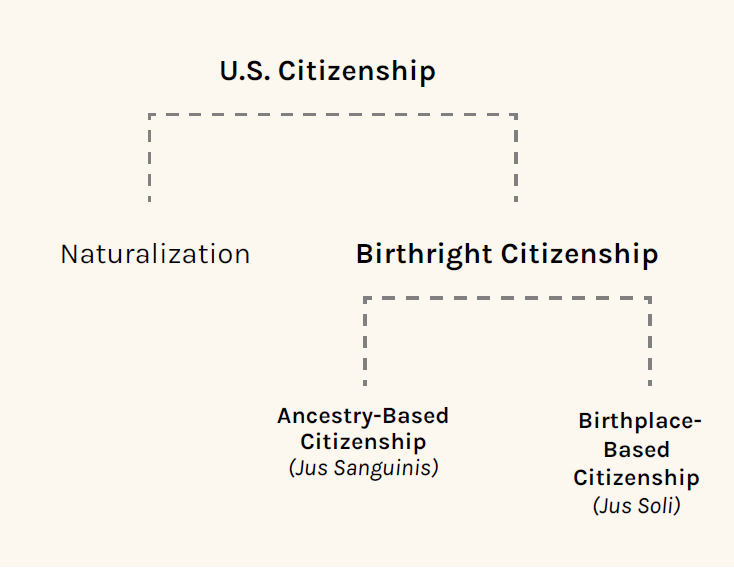
In law, birthright citizenship is simply defined as automatically granting citizenship (as a legal status) to children upon their birth.2 This status comes in two forms: ancestry-based citizenship (jus sanguinis, a Latin term meaning “right of blood”), or birthplace-based citizenship3 (jus soli, Latin for “right of the soil).”4
Today, many nations use a combination of citizenship through ancestry and citizenship by place of birth to determine birthright citizenship—granting citizenship to some infants based on their parentage and others based on being born within their territory. However, both methods of conveying citizenship can be applied broadly or in more restricted ways. A government can restrict ancestry-based citizenship by imposing residency requirements on the citizen parents, capping the number of generations who can pass citizenship down to a child, or implementing more stringent rules when only one parent is a citizen. It can also restrict birthplace-based citizenship by granting citizenship to babies born on its territory only if their parents hold certain immigration statuses.
| Restricted | Unrestricted | |
|---|---|---|
Birthplace-Based Citizenship (Jus Soli) | Anyone born within the state’s territory is a citizen at birth. Restrictions apply based on parents’ citizenship or immigration status. | Anyone born within the state’s territory is a citizen at birth regardless of the parents’ citizenship or immigration status. |
Ancestry-Based Citizenship (Jus Sanguinis) | Anyone born to citizen parents is a citizen of the state at birth. Restrictions apply regarding how many generations citizenship can be passed down or if only one parent is a citizen. | Anyone born to citizen parents is a citizen of the state at birth. Little to no restrictions apply on how many generations citizenship can be passed down. |
Birthright Citizenship in the United States
Currently, the United States uses a combination of unrestricted birthplace-based citizenship (jus soli) guaranteed by the Fourteenth Amendment to the Constitution, and restricted ancestry-based citizenship (jus sanguinis) granted through the Immigration and Nationality Act (INA), as amended by the Child Citizenship Act of 2000, to determine birthright citizenship.5 The first means that anyone born in the United States is automatically a citizen at birth irrespective of parents’ citizenship status. The second means that children born abroad to at least one U.S. citizen parent may be entitled to U.S. citizenship, if they meet certain statutory requirements.6 There are more requirements to qualify for U.S. citizenship based on being born abroad to a U.S. citizen parent than there are to qualify for U.S. citizenship based on birth on U.S. soil.
Examples of Politicians Who Acquired Birthright Citizenship Through Birthplace or Ancestry
| Name | Office Held | Birthplace | Citizenship | Description |
|---|---|---|---|---|
Ted Cruz | U.S. Senator (TX) | Canada | Ancestry | Born to a U.S.-born mother, and a Cuban-born father. |
Chris Van Hollen | U.S. Senator (MD) | Pakistan | Ancestry | Born to two U.S.-born parents. |
Sheila Cherfilus-McCormick | U.S. Rep. (FL 20th District) | New York, U.S. | Birthplace | Born to Haitian immigrant parents. |
Delia Ramirez | U.S. Rep. (IL 3rd District) | Illinois, U.S. | Birthplace | Born to Guatemalan immigrant parents. |
Nikki Haley | Former Governor of South Carolina | South Carolina, U.S. | Birthplace | Born to Indian immigrant parents. |
Examples of Famous Americans Who Acquired Birthright Citizenship Through Birthplace or Ancestry
| Name | Profession | Place of Birth | Citizenship | Description |
|---|---|---|---|---|
Michelle Kwan | World Champion Figure Skater | California, U.S. | Birthplace | Born to Chinese immigrant parents. |
Amy Adams | Actress | Italy | Ancestry | Born to two U.S. citizen parents. |
Johnny Galecki | Actor | Belgium | Ancestry | Born to two U.S. citizen parents. |
Lily Collins | Actress | England | Ancestry | Born to one U.S. citizen parent. |
Why Does the United States Grant Citizenship to All Children Born in the Country?
Countries in North and South America generally think about birthright citizenship differently than those in the rest of the world. By and large, granting ancestry-based citizenship is nearly universal throughout the world. On the other hand, granting citizenship to all children born in a country’s territory became more common in the Americas. After the founding of the United States, other countries in the Western Hemisphere also adopted unrestricted birthplace-based citizenship. A 2018 survey found that of the 33 countries in the world that have adopted an unrestricted birthplace-based citizenship model, only six of those are located outside the Americas and the Caribbean. Some researchers have argued that the founders of the United States, in seeking to increase the immigration of “ambitious” Europeans, purposefully adopted birthplace citizenship principles from various existing sources including longstanding theories of natural law and English law.7 Thus, despite unrestricted birthplace-based citizenship being disproportionately popular among the countries of the Western Hemisphere, none of which is older than the eighteenth century,8 researchers trace the roots of birthplace-based citizenship to much older traditions adopted by the founders of the United States.
The Fourteenth Amendment and its Interpretations
The concept of birthplace-based citizenship has been established for over 400 years, particularly under English common law. Calvin’s Case was a 1608 English legal decision that shaped American understandings of birthplace-based citizenship.9 The case ruled that a child born in Scotland would be an English subject under common law and entitled to the benefits of English law. This ruling stipulated that people born on sovereign land, no matter the status of their parents, were “natural subjects” of the kingdom.10
The Fourteenth Amendment and the Citizenship Clause
The 1844 New York court case of Lynch v. Clarke11 was one of the first cases to address the concept of birthplace-based citizenship in the United States, even though it did so in the context of deciding an inheritance in New York. Julia Lynch was born in New York to two Irish parents who were temporary visitors in the United States.12 Soon after her birth, Lynch and her family returned to Ireland without declaring an intent to be naturalized.13 Although she remained in Ireland for twenty years after her birth, a U.S. court later used the principle of jus soli, or birthplace-based citizenship, to decide that she was an American citizen at the time of her birth. The Court ruled that her prolonged residence in Ireland succeeding her birth did not affect her birthright citizenship in the United States. Judge Lewis Sandford wrote in 1844, “I can entertain no doubt, but that by the law of the United States, every person born within the dominions and allegiance of the United States, whatever were the situation of his parents, is a natural born citizen.14 The Lynch case is one of the few examples of how courts at the time applied the basic principle of citizenship based on some people’s birth in the United States.
But such decisions only addressed the citizenship of white persons born in the United States, and those citizenship rights did not apply to all those born inside the country. Thirteen years after Lynch, the Supreme Court’s infamous Dred Scott15 decision addressed the question of whether the descendants of people who were enslaved and brought to the United States were citizens entitled to the relevant rights and privileges granted to citizens under the Constitution.16 The Court enshrined the principle that enslaved people and people of African descent were not citizens of the United States, and in doing so rejected birthright citizenship for people of color and abrogated the concept that Black Americans were citizens of the United States by virtue of being born in the country.17
The Fourteenth Amendment, which guaranteed certain rights for African Americans in all the states, was enacted following the end of the Civil War and sought to rectify the Dred Scott decision.18 Among other things, the Fourteenth Amendment sought to ensure birthright citizenship for everyone born on U.S. territory regardless of race.19
The first sentence of the Fourteenth Amendment states the following: “All persons born or naturalized in the United States, and subject to the jurisdiction thereof, are citizens of the United States and of the state wherein they reside.”20 While the fight for citizenship recognition continued well after the ratification of the Fourteenth Amendment, the aim of the Amendment was to eliminate the existence of a class of people who were subjected to American law, but excluded from American legal rights.21 In essence, the use of jus soli to confer citizenship to those born on U.S. soil was to ensure that all those born within the country’s territory, regardless of race, would be citizens.22 Nevertheless, some groups continued to be excluded from recognition as citizens on the basis of race.
United States v. Wong Kim Ark
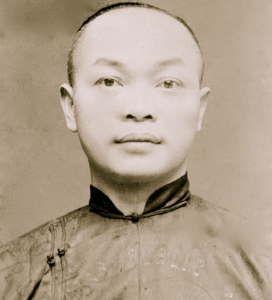
The Fourteenth Amendment became the basis for landmark Supreme Court rulings over the years addressing birthright citizenship.23 Most notably, the 1898 ruling in United States v. Wong Kim Ark established the explicit precedent that any person born in the United States is a citizen by birth.24
The Citizenship Clause’s stipulation about being “subject to the jurisdiction” of the United States had created some uncertainty about who would be excepted on those grounds. Additionally, in the 1880s, Congress began to pass restrictive immigration laws that declared some people permanently ineligible for citizenship, including Chinese immigrants under the Chinese Exclusion Act.25
Wong Kim Ark was born in the United States to Chinese parents, though he frequently returned to China on temporary visits.26 When attempting to return to the United States in 1890, Wong Kim Ark was barred from entering the country under the Chinese Exclusion Act because under the law, he could be excluded from the United States based on his Chinese ancestry.27
However, the Supreme Court held in a 6-2 decision that because Wong was born in the United States, and his parents were not “carrying on business” or “employed in any diplomatic or official capacity under the Emperor of China”—implying that these would be the only reasons Wong might not have counted as “subject to the jurisdiction” of the United States—Wong was indeed a U.S. citizen.28 The Supreme Court noted that application of the Chinese Exclusion Act could not supersede the mandate of the Fourteenth Amendment.29
In a particularly telling passage from the case, the Court asked how citizenship could be denied to children of Chinese immigrants when it extended to children of Scottish, German, and other immigrants.30 This passage not only underlined that citizenship in the United States was not racially restricted, but specifically established that even though Congress had said Chinese immigrants themselves could never become U.S. citizens—the law would not be repealed until 194331—their children remained “subject to the jurisdiction” of the United States and therefore qualified for U.S. citizenship at birth. The case clarified that anyone born in the United States was a citizen under the Court’s interpretation of the Fourteenth Amendment, regardless of the parents’ immigration status, and the case has been established precedent for more than 125 years.
The Indian Citizenship Act of 1924
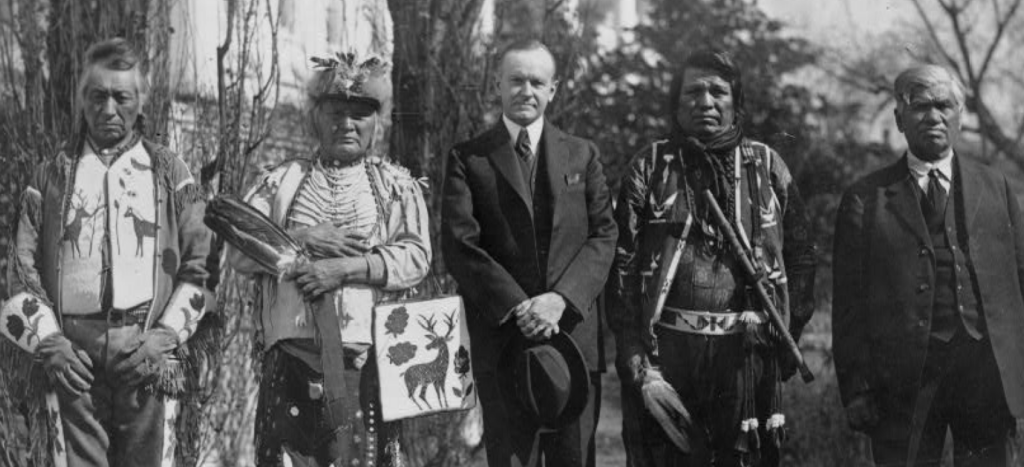
Native Americans were one of the last groups in the United States to be granted birthright citizenship. While the government recognized Black Americans’ citizenship with the passage of the Fourteenth Amendment, the government interpreted the law to deny birthright citizenship to Native Americans.32 The 1884 case of Elk v. Wilkins raised the issue of whether the Fourteenth Amendment’s clause requiring individuals be subject to the “jurisdiction” of the United States to be deemed U.S. citizens included Native American tribes.33 In this case, John Elk, a Native American born on a reservation, claimed birthright citizenship under the Fourteenth Amendment.34 However, the Supreme Court ruled in a 7-2 decision that Native American tribes, although located within the territorial limits of the United States, were outside the “jurisdiction” of the United States because tribes were treated as “alien nations, distinct political communities” with whom the United States only habitually dealt with.35 The court ruled that Native Americans owed immediate allegiance to their tribes, and not the United States.36 This interpretation was not changed by the ruling in Wong Kim Ark eight years later—after that decision, children of immigrants in the United States were “subject to the jurisdiction” of the government, but for the purposes of citizenship Native Americans still were not.
Through the 1924 Indian Citizenship Act, Congress granted citizenship to all Native Americans born within the territorial limits of the United States.37 The new law meant that Native Americans were no longer required to shift allegiance from their tribe to the United States as the law no longer recognized that such dual allegiance as a conflict.38
Trump v. Barbara
In the years since Wong Kim Ark was decided, the Supreme Court reaffirmed the concept that undocumented immigrants and their children are “subject to the jurisdiction” of the United States. In the 1982 decision Plyler v. Doe, which held that undocumented children have a right to an education under the Fourteenth Amendment, the Supreme Court observed that there is “no plausible distinction”39 between documented and undocumented immigrants in regard to jurisdiction, as both are “subject to the full range of obligations imposed by [the location’s] civil and criminal laws.”40
The Supreme Court’s most direct reaffirmation of the Wong Kim Ark decision came when it decided Trump v. Barbara. On January 20, 2025, President Trump issued Executive Order 14156: Protecting the Meaning and Value of American Citizenship, aimed at ending birthright citizenship for 1) a child of an undocumented mother and a father who is not a citizen or lawful permanent resident; and 2) a child of a mother who is a temporary visitor and a father who is not a citizen or lawful permanent resident, making ancestry a criteria for acquiring citizenship.41
PROPOSED LIMITS TO BIRTHRIGHT CITIZENSHIP VIA EXECUTIVE ORDER 14156
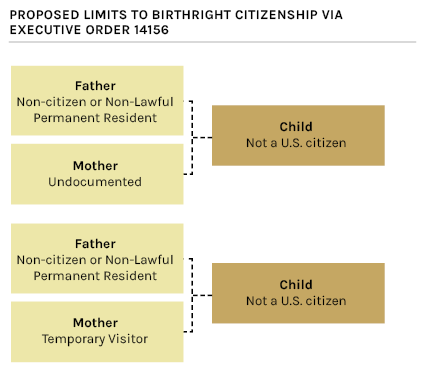
Executive Order 14156 prompted several lawsuits including from several states in multiple jurisdictions,42 immigrant right groups,43 and expecting mothers44 claiming the executive order violated the Fourteenth Amendment of the Constitution as well as federal law. On June 30, 2026, the Supreme Court ruled that the Trump administration’s attempt to end birthright citizenship violated the Fourteenth Amendment to the U.S. Constitution. The decision, written by Chief Justice John Roberts, and joined by four other justices, unequivocally stated that Wong Kim Ark held that the Citizenship Clause of the Fourteenth Amendment incorporates the common law that granted citizenship to all children born in the United States and are subject to its powers, and that there was no reason to deviate from such holding. The holding rebuked the Trump administration’s position that children subject to the executive order were not “subject to the jurisdiction” of the United States.
Four justices opined that the executive order did not violate the Fourteenth Amendment. Under the dissenters’ view, the concept of citizenship rests primarily upon where a person is “domiciled” and thus concluded that people in the country temporarily or here without status cannot establish “domicile” in the United States. Notably, however, Justice Brett Kavanaugh agreed with the outcome of the Court’s majority but for a different reason: the executive order’s ending of birthright citizenship violated the immigration laws that codified the birthright citizenship requirements of the Fourteenth Amendment but did not violate the Fourteenth Amendment itself. This approach suggests that Congress could change these requirements by amending such law, an approach the majority of justices declined to adopt.
In light of the majority’s decision, all children born on U.S. soil continue to be U.S. citizens after Trump v. Barbara.
Who is Eligible for Birthright Citizenship?
Today, almost everyone born on U.S. territory is automatically granted citizenship at birth.
What Does United States Territory Mean?
The Fourteenth Amendment grants citizenship to people born in the United States and “subject to the jurisdiction thereof.” This includes: the fifty states,45 U.S. territories,46 U.S. territorial waters,47 foreign ships in U.S. internal waters,48 and airspace above U.S. land, internal waters, and territorial seas.49 It excludes U.S. registered aircrafts outside U.S. airspace, as well as U.S. military bases, embassies, or consulates abroad.50
Who is Excluded from Birthright Citizenship?
The Fourteenth Amendment states that only those “subject to the jurisdiction of the United States” are entitled to citizenship. Children of diplomats have been deemed to not be subject to the jurisdiction of the United States and are therefore not U.S. citizens under the Fourteenth Amendment.51 Children born to soldiers considered enemy invaders during a hostile occupation of the United States, who are not subject to U.S. law, also are excluded from birthright citizenship.52
The 2021 decision in Fitisemanu v. United States53 ruled that unlike Americans born in incorporated U.S. territories, those born in the unincorporated territories of American Samoa are not entitled to birthright citizenship without an act of Congress creating that right. They are considered “non-citizen nationals.”54
Can Birthright Citizenship Be Taken Away?
Because birthplace-based citizenship is enshrined in the Constitution, taking it away would only be possible through the passage of a new constitutional amendment—requiring a two-thirds vote in both the House and Senate, as well as ratification by three-quarters of the states55—or through a radical reinterpretation of the Fourteenth Amendment by the Supreme Court as affirmed in its decisions in Wong Kim Ark and Trump v. Barbara. While Congress could also try to restrict birthplace-based birthright citizenship through legislation, this type of legislation would likely violate the Fourteenth Amendment given that the Supreme Court in Trump v. Barbara found that birthright citizenship is enshrined in the Constitution.
Relinquishing U.S. Citizenship
In rejecting the notion that Congress has authority to take away someone’s U.S. citizenship, the Supreme Court’s 1967 decision in Afroyim v. Rusk forcefully recognized the constitutional right to remain a citizen, unless an individual voluntarily relinquishes that right.56 Under current law, loss of birthright citizenship could only occur through voluntary relinquishment of citizenship via acts that include but are not limited to: declaring allegiance to a foreign state; formally renouncing U.S. nationality; or committing any act of treason or attempting to overthrow the United States.
Conclusion
The Fourteenth Amendment to the Constitution guarantees citizenship to any child born within the United States, with limited exceptions. Revoking this right would require amending the U.S. Constitution, or an abrupt divergence from centuries of established precedent and legal principles that date back to before the founding of this country. The U.S. Supreme Court was unwilling to do this in Trump v. Barbara, and thus children of undocumented immigrants remain U.S. citizens.
-
U.S. Const. amend. XIV. ↩︎
-
Iseult Honohan, Birthright Citizenship, last modified May 23, 2024, https://www.oxfordbibliographies.com/display/document/obo-9780199756223/obo-9780199756223-0344.xml. ↩︎
-
Vol. 8, Foreign Affairs Manual § 301.1-1. ↩︎
-
Ibid. ↩︎
-
Child Citizenship Act of 2000, Pub. L. No. 106-395, 114 Stat. 1631 (2000). ↩︎
-
8 U.S.C. §§ 1401-1408. ↩︎
-
Thomas Lee, “Natural Born Citizen,” 67 Am. U. L. Rev. 327, 335 (2017). ↩︎
-
Staff of the Global Research Directorate, Law Library of Congress, Birthright Citizenship Around the World, November 2018, https://maint.loc.gov/law/help/birthright-citizenship/birthright-citizenship-around-the-world.pdf. ↩︎
-
Calvin’s Case (1608), 77 ER 377, (1608) Co Rep 1a. ↩︎
-
Polly J. Price, Natural Law and Birthright Citizenship in Calvin’s Case (1608), January 15, 1997, 73-145, https://papers.ssrn.com/sol3/papers.cfm?abstract_id=3157386. ↩︎
-
1 Sand. Ch. 583. ↩︎
-
Id. at 587-588. ↩︎
-
Id. ↩︎
-
Id. at 663. ↩︎
-
Dred Scott v. Sandford, 60 U.S. 393 (1857). The case name is unrelated to the Judge Lewis Sandford mentioned above. ↩︎
-
Id. at 403. ↩︎
-
Akhil Reed Amar and Steven G. Calabresi, What the Constitution Really Says About Birthright Citizenship, October 31, 2018, https://time.com/5440454/constitution-birthright-citizenship/. ↩︎
-
David Olson, Historical Context for the Fourteenth Amendment’s Disqualification Clause, January 11, 2024, https://retroreport.org/articles/historical-context-for-the-Fourteenth-amendments-disqualification-clause/. ↩︎
-
Rogers M. Smith, Birthright Citizenship and the Fourteenth Amendment in 1868 and 2008, 2009, 1329-1335, https://scholarship.law.upenn.edu/cgi/viewcontent.cgi?article=1175&context=jcl. ↩︎
-
U.S. Const. amend. XIV, § 2. ↩︎
-
Katherine Culliton-González, Born in the Americas: Birthright Citizenship and Human Rights, September 2009, 127-182, https://journals.law.harvard.edu/hrj/wp-content/uploads/sites/83/2009/09/Culliton-Gonzalez.pdf. ↩︎
-
Ibid. ↩︎
-
History.com, 14th Amendment, updated December 20, 2023, https://www.history.com/topics/black-history/Fourteenth-amendment. ↩︎
-
169 U.S. 649, 693 (1898). ↩︎
-
Id. at 654. ↩︎
-
Id. at 652 – 653. ↩︎
-
Id. at 699. ↩︎
-
Id. at 705. ↩︎
-
Id. at 699 – 700. ↩︎
-
Katherine Culliton-González, Born in the Americas: Birthright Citizenship and Human Rights, September 2009, 127-182, https://journals.law.harvard.edu/hrj/wp-content/uploads/sites/83/2009/09/Culliton-Gonzalez.pdf. ↩︎
-
Office of the Historian, U.S. Dept. of State, Repeal of the Chinese Exclusion Act, 1943, https://history.state.gov/milestones/1937-1945/chinese-exclusion-act-repeal. ↩︎
-
Becky Little, Native Americans’ Long Journey to US Citizenship and Voting Rights, updated November 7, 2023, https://www.history.com/news/native-american-voting-rights-citizenship. ↩︎
-
Elk v. Wilkins, 112 U.S. 94 (1884). ↩︎
-
Id. at 95. ↩︎
-
Id. at 99. ↩︎
-
Id. at 99. ↩︎
-
Library of Congress, Today in History – June 2, last accessed September 5, 2024, https://www.loc.gov/item/today-in-history/june-02/. ↩︎
-
Marian L. Smith, The INS and the Singular Status of North American Indians, 1997, 131-154, https://escholarship.org/uc/item/890323cm. ↩︎
-
Plyler v. Doe, 457 U.S. 202, 212 n. 10 (1982). ↩︎
-
Id. at 215. ↩︎
-
Executive Order No. 14156, “Protecting the Meaning and Value of American Citizenship,” January 20, 2025, Sec. 1, https://www.whitehouse.gov/presidential-actions/2025/01/protecting-the-meaning-and-value-of-american-citizenship/. ↩︎
-
Zach Schonfeld, “Trump’s birthright citizenship executive order prompts blitz of litigation,” The Hill, January 23, 2025, https://thehill.com/regulation/court-battles/5103514-trump-birthright-citizenship-lawsuits/. ↩︎
-
Complaint, New Hampshire Indonesian Support v. Donald J. Trump (2025) (No. 1:25-cv-38), https://assets.aclu.org/live/uploads/2025/01/0176.pdf. ↩︎
-
Complaint, CASA, Inc v. Trump (2025) (No. 8:25-cv-00201-DLB), https://wearecasa.org/pregnant-moms-asap-casa-sue-trump-protect-birthright-citizenship/. ↩︎
-
8 U.S.C. §§ 1404 – 1405. ↩︎
-
8 U.S.C. §§ 1402, 1403, 1406, 1407, and 48 U.S.C. § 1801. ↩︎
-
8 FAM § 301.1-4. ↩︎
-
8 FAM § 301.1-3. ↩︎
-
8 FAM § 301.1-3. ↩︎
-
8 FAM § 301.1-3. ↩︎
-
8 C.F.R. § 101.3(a). ↩︎
-
8 C.F.R. § 101.3(a). ↩︎
-
Fitisemanu v. United States, 1 F.4th 862, 881 (10th Cir. 2021). ↩︎
-
Peter J. Spiro, Citizenship, What Everyone Needs to Know, November 5, 2019, 6-23, https://www.google.com/books/edition/Citizenship/jCy7DwAAQBAJ?hl=en&gbpv=1&printsec=frontcover. ↩︎
-
White House, The Constitution, last accessed September 9, 2024, https://www.whitehouse.gov/about-the-white-house/our-government/the-constitution/. ↩︎
-
Afroyim v. Rusk, 387 U.S. 253, 268 (1967). ↩︎