Family-Based Immigration
Through family-based immigration, U.S. citizens and lawful permanent residents can sponsor relatives for immigration. We aim to be a leading force in transforming family-based immigration policy in order to maintain family unity, foster cohesive communities, and strengthen America’s economic growth. Read more about our approach below.

Collateral Damage: Children in the Aftermath of Immigration Raids
The collateral damage left in the wake of internal immigration enforcement is far too often overlooked in the immigration debate—especially considering that children bear the brunt of such enforcement policies. There are roughly 5.5 million children currently living in the U.S. with at least one unauthorized parent, and at least three-quarters of these children are U.S. born citizens. The Department of Homeland Security (DHS) estimates that over the last 10 years, more than 100,000 immigrant parents of U.S. citizen children have been deported from the United States. As DHS continues to increases its enforcement-heavy budget, it’s important to consider the serous risks raids and other ICE actions that separate parents and children pose to children’s immediate safety, economic security, well-being, and long-term development. Read More

Got Faith? A Closer Look at the Religious Movement for Immigration Reform
Today, hundreds of Evangelical leaders from around the country will join hands to raise awareness for comprehensive immigration reform during a National Day of Prayer. Like many faith groups, Evangelicals are the most recent to sign onto the national religious effort to “act on the Biblical mandate of compassion and justice toward immigrants” and call for reform of our broken immigration system. Some restrictionist groups, however, continue to criticize the role of religion and faith in the immigration reform movement—some even using the Bible as a weapon to condemn immigrants as law-breakers and sinners. Read More

Granting Temporary Protective Status (TPS) to Unauthorized Haitians Now an Urgent Matter
Tuesday’s devastating earthquake in Haiti is the latest and deadliest tragedy to befall one of the world’s poorest countries. As the death toll mounts and the full measure of the destruction is taken in, the call for urgent humanitarian relief is already being answered by the United States. Presumably, those relief efforts will be supplemented by additional long-term foreign aid packages, much like the relief that followed a series of hurricanes and tropical storms in 2008. Whenever a disaster of this magnitude occurs, however, the immigration arm of the government also must respond. DHS has already announced that it is temporarily suspending the removal of Haitians scheduled to be returned to their country. Thousands more—some here as temporary visitors, others seeking asylum or currently in immigration proceedings, and many more here as undocumented immigrants—face an uncertain future. Read More

Immigration Reform Now a Matter of “How”
There are plenty of genuine issues worthy of debate in immigration reform—how to really create secure borders and communities, how to predict and manage future immigration flows, how to implement a fair and workable employment verification system, and how to ensure that legal immigration incorporates key values represented by family and work. But what is no longer on the table is whether we should be doing immigration reform, particularly legalization of the undocumented. Yesterday’s release of the IPC/CAP report finally puts to rest the question of whether immigration reform is good for the country. The answer—a resounding “Yes!” Read More

A Closer Look at Immigration Reform Legislation in the New Year
Everyone pulled out the sports analogies last week when Congressman Luis Gutierrez and his 91 co-sponsors introduced H.R. 4321, the Comprehensive Immigration Reform for America’s Security and Prosperity Act of 2009—and rightly so, as this bill marks the opening bell in the 2010 immigration debate. It is not only the first major piece of comprehensive reform legislation introduced in the 111th Congress, but the first since the last debate on immigration reform, which took place in May and June of 2007 in the Senate. Read More
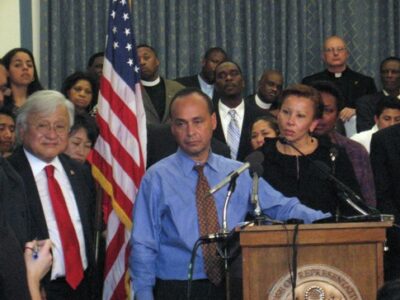
Congressman Luis Gutierrez Introduces Comprehensive Immigration Reform for America’s Security and Prosperity Act of 2009
Today, in a room filled with supporters and shouts of “Si, Se Puede,” Congressman Luis V. Gutierrez (D-IL) held a press conference to introduce the Comprehensive Immigration Reform for America’s Security and Prosperity Act of 2009 (CIR ASAP). Congressman Gutierrez introduced the immigration reform bill—which at last count had 89 original co-sponsors including the Congressional Hispanic, Black, Progressive, and Asian Pacific American Caucuses—before Congress heads home for the holidays “so that there is no excuse for inaction in the New Year.” Read More

Studies Show Latinos Climb Socio-Economic Ladder of Success
As a front-page story in today’s Washington Post reminds us: “Not since the last great wave of immigration to the United States around 1900 has the country’s economic future been so closely entwined with the generational progress of an immigrant group.” The story highlights the degree to which the children of immigrants from Latin America have become crucial to sustaining the working-age population and tax base of the nation—particularly as more and more of the 75 million Baby Boomers retire. Moreover, the parents of these children most likely would not have even come to this country if not for the U.S. economy’s past demand for workers to fill less-skilled jobs—demand which was not being adequately met by the rapidly aging and better-educated native-born labor force. The Post story also casts a spotlight on the insecurities and anxieties of commentators who feel that Latino immigrants and their descendants aren’t integrating into U.S. society and moving up the socio-economic ladder “fast enough.” Although these concerns are certainly understandable, they are as unjustified now as they were a century ago when they were directed at immigrants from southern and eastern Europe. Read More

How Some Houston Charities Stole Christmas…Almost
This week, the Houston Chronicle reported on several Houston area charities that distribute Christmas gifts to needy children—among them, the Salvation Army, Outreach Program Inc., and West Houston Assistance Ministries. Giving to the needy, especially during an economic recession, is truly an admirable mission—except this year the card attached reads “Immigration status, please.” After all, nothing says “holiday cheer” like demanding documentation from the needy. Read More

“They” Are “Us”: The Devastating Effects of Broken Immigration Policy on Children in Immigrant Families
The legacy of our broken immigration system extends far beyond our borders or the job market. The price paid by families caught within the system can be devastating, especially when we fail to pay attention to the importance of integrating newcomers into American life. A New York Times editorial this week follows a study that highlights the importance of integrating new Americans and their children. Read More

Supreme Court Hears Case about Immigrants’ Access to Federal Court Review
Last week, the Supreme Court heard arguments in a case that involves an important safeguard for immigrants facing removal from the United States—access to federal court review. The case, Kucana v. Holder, was brought by an asylum seeker from Albania. Mr. Kucana is seeking court review of a government decision depriving him of the opportunity to present his asylum claim. The Seventh Circuit Court of Appeals (based in Chicago) refused to review the government’s decision. Instead, the Seventh Circuit found that in his case, the government has unfettered discretion over a potentially life and death decision. The Supreme Court now is considering whether the Seventh Circuit was right. Read More
All gifts are matched dollar for dollar up to $75,000
No one should face the immigration system alone