Immigration at the Border

Border Patrol Agents as Interpreters Along the Northern Border: Unwise Policy, Illegal Practice
Advocates along the Northern Border report a recent, sharp increase in the use of U.S. Border Patrol (USBP) agents to provide interpretation services to state and local law enforcement officers and emergency responders. This most often occurs when an officer or responder encounters an individual who does not speak English and proactively reaches out to USBP for assistance. But it has also occurred when USBP agents respond to an incident report in lieu of, or in addition to, local law enforcement officers. In other cases, USBP agents have reportedly begun responding to 911 emergency assistance calls, especially if the caller is known or perceived not to speak English. Much of this activity appears to have been precipitated by the fact that the U.S.-Canada border has undergone a dramatic transformation, including an influx of newly assigned USBP agents.Immigrants, their advocates, and community members are reporting—and official statistics confirm—that there are simply too many USBP agents on the ground, apparently with too much time on their hands, who lack adherence to stated priorities.This special report by Lisa Graybill for the Immigration Policy Center lays out the problems with border patrol agents serving as translators and make recommendations intended to promote Title VI compliance, maintain the integrity of the USBP mission on the Northern Border, and protect the rights of immigrants and their families who call the Northern Border home. Listen to the teleconference. Read More

Agriculture Industry Harmed by Restrictive State Immigration Laws
The American agricultural industry is facing billions of dollars in losses due to labor shortages resulting from recent anti-immigrant laws passed in various states around the country. The American farming industry is heavily dependent on undocumented workers, and according to a recent article in Time Magazine, has had an extremely difficult time replacing those who have fled as a result of laws like Arizona’s SB 1070 or Alabama’s HB 56. Read More

Immigrant Detention and the Private Prison Industry
The latest data on immigration enforcement show that U.S. Immigration and Customs Enforcement (ICE) detained a record high of 429,247 noncitizens in the 2011 fiscal year, an increase of 18 percent over 2010. Immigration detention has been steadily increasing over the last two decades. A new report by Justice Strategies suggests this increase is largely due to the efforts of private prison companies. Read More

As Chicago Passes Anti-Detainer Ordinance, TRUST Act Awaits Signature in California
Lost amongst media coverage of the ongoing teachers’ strike was the passage in Chicago last week of a historic measure that largely prohibits local police from detaining individuals on behalf of federal immigration authorities. Dubbed the “Welcoming City Ordinance,” the measure makes Chicago the latest jurisdiction to push back against immigration “detainers,” the lynchpin of the controversial Secure Communities program. Read More

Immigrant Integration is a Two-Way Street
The process by which immigrants integrate into the economic and social fabric of the United States is very much a two-way street. Naturally, immigrants must harbor the desire to climb the socioeconomic ladder of success. But there must be a ladder for them to climb. If the community within which immigrants live and work makes the collective decision to deprive them of opportunities, then their upward mobility is hindered—to the social and economic detriment of the entire community. Yet, if the community actually welcomes newcomers and helps to facilitate their upward mobility, then the community eventually reaps the rewards of having workers and neighbors who are more highly skilled, more integrated, and more heavily invested in the community itself. Read More
What Early DACA Application Numbers Tell Us About the Future of the Program
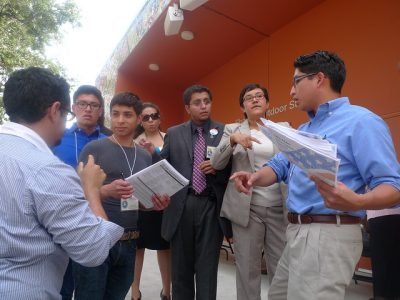
It hasn’t even been a month since the United States Citizenship and Immigration Services (USCIS) first started accepting requests for deferred action under its Deferred Action for Childhood Arrivals (DACA) initiative, yet the New York Times reported this week that the first approvals are already on their way. The Times also reported that the agency has received 72,000 applications as of September 11—almost double the 40,000 reported in the Wall Street Journal just the day before. That’s not bad at all for a program that was only announced three months ago and put into place by the government in 60 days. Read More

Alabama Doubles Down, Appeals Ruling on HB 56
Late last month, after a panel of federal judges unanimously struck down major provisions of Alabama HB 56, a statement issued by Gov. Robert Bentley gave reason to hope the state would graciously concede defeat. Calling it time “to move past court battles,” Bentley said Alabama should turn its focus to the handful of provisions that the panel declined to enjoin. In legal papers filed on Monday, however, Alabama challenged the panel’s ruling and asked for a new hearing before all active judges on the federal appeals court. Although such requests are rarely granted, the filing suggests that Alabama, like Arizona, is prepared to defend its law all the way to the Supreme Court. Read More

Clearing Up the Controversy over the Number of ICE “Removals”
It is by now well-known that more immigrants have been deported on an annual basis since President Obama took office than at any time in U.S. history. Late last month, however, Lamar Smith (R-Tex.) issued a statement seeking to cast doubt on this widely accepted fact by alleging that U.S. Immigration and Customs Enforcement (ICE) inflated its record-breaking deportation figures for 2011. Although the accusations are somewhat complicated, the truth is straightforward: despite overstating its total number of “removals,” ICE deported the highest number of immigrants last year in the agency’s history. Read More

Inspector General Finds Serious Problems with US-VISIT Program
The Department of Homeland Security’s (DHS) Office of Inspector General (OIG) recently released results of their investigation into the US-VISIT program. US-VISIT was created after 9/11 to track noncitizens’ entries into and exits from the U.S. to identify national security threats, individuals entering with fraudulent identities, and visa overstays. Through US-VISIT, fingerprints and digital photographs are taken of all noncitizens entering the U.S. and matched to biographical information. The exit portion of US-VISIT has never been fully implemented. Read More

Busting Myths About the California TRUST Act
As we reported last week, the TRUST Act—a bill that would prevent local law enforcement agencies from honoring all requests to detain immigrants on the federal government’s behalf—has cleared the California state legislature and is awaiting the signature of state Governor Jerry Brown. Meanwhile, restrictionists and other proponents of Arizona-style immigration laws have begun mounting a media campaign seeking to discredit the common-sense piece of legislation. Unfortunately, but not surprisingly, the primary claims of the TRUST Act’s opponents simply don’t stand up to scrutiny. Read More
