Immigration Reform
The last time Congress updated our legal immigration system was November 1990, one month before the World Wide Web went online. We are long overdue for comprehensive immigration reform.
Through immigration reform, we can provide noncitizens with a system of justice that provides due process of law and a meaningful opportunity to be heard. Because it can be a contentious and wide-ranging issue, we aim to provide advocates with facts and work to move bipartisan solutions forward. Read more about topics like legalization for undocumented immigrants and border security below.
Comprehensive Immigration Reform is More than a Piece of Legislation
Realistically, the likelihood of a comprehensive immigration reform (CIR) bill passing before the midterm elections is pretty small. News reports indicate that many advocates are pivoting to supporting more targeted immigration measures, such as DREAM Act or AgJobs, both of which have been introduced and have numerous co-sponsors already. Inevitably, these reports talk about backtracking, moving to a piecemeal approach or abandoning CIR. And then there is usually some kind of smug, I-told-you-so comment from an immigration restrictionist—one that revels in the supposed failure of comprehensive immigration reform. But CIR is more than a piece of legislation. It’s a goal—one which requires long-term commitment and a belief in the fundamental goodness of Americans. Read More
Congressional Hearing Dissects the Many Failures of SBInet
At a hearing held jointly today by two subcommittees of the House Homeland Security Committee, lawmakers and witnesses took turns dissecting the many faults and failures of the Department of Homeland Security’s ill-fated Secure Border Initiative Network, or SBInet—the $1.1 billion effort led by the Boeing Corporation to create a “virtual fence” along the U.S.-Mexico border through the deployment of cameras, sensors, and monitoring systems. SBInet is the high-tech counterpart to SBI Tactical Infrastructure, which involves the construction of physical fencing along the border as well. The hearing was devoted to answering a key question about SBInet: “Does it pass the border security test?” Given that Homeland Security Secretary Janet Napolitano froze funding for SBInet in March because of the program’s failure to live up to expectations, it is not surprising that the answer to this question from virtually everyone who spoke at the hearing was a resounding “No.” Read More
Deporting America’s Future: Harvard Student Pushes for DREAM Act
Harvard sophomore, Eric Balderas, knows why the DREAM Act is important to so many. Earlier this month, Immigration and Customs Enforcement (ICE) picked up Balderas in Boston on his way to visit his mother in San Antonio, Texas. Balderas now faces the possibility of deportation at a hearing next month. The 19 year old biology major was valedictorian of his high school class and is on a full scholarship at Harvard. Sadly, Balderas is just one of roughly 1.5 million unauthorized immigrant children—many of whom don’t speak Spanish and consider themselves American—currently living in the U.S. who are at risk for deportation. How many of America’s talented youth must the U.S. deport before Congress musters the courage to act? Read More
Ending Birthright Citizenship Won’t Solve Our Immigration Problems
The people who brought you SB1070 in Arizona are now preparing to challenge one of the fundamental principles of the U.S. Constitution—birthright citizenship. Birthright citizenship, or the principle of jus soli, means that any person born within the territory of the U.S is a citizen, regardless of the citizenship of one’s parents. This principle was established well before the U.S. Constitution, and was enshrined in the Fourteenth Amendment. It was necessary to include the citizenship clause in the Fourteenth Amendment because the Supreme Court’s Dred Scott decision of 1857 had denied citizenship to the children of slaves. Following the Civil War, the Fourteenth Amendment righted that injustice and became the foundation for civil rights law, equal protection, and due process in the United States. Read More
SB 1070 “Gets Tough” on Arizona’s Housing Market
With only six weeks until Arizona’s immigration enforcement law goes into effect, area housing analysts are already expecting the worst. According to the Arizona Republic, housing experts anticipate that SB 1070 will not only drive illegal immigrants out of the state, but legal residents and potential new homebuyers with them—“departures from a state where growth is the economic foundation.” The resulting exodus will likely spur more foreclosures and create more vacant homes and apartments, which as real-estate analysts point out, will scare off potential homebuyers who fear lower home values. With a budget deficit of $4.5 billion and an economy struggling to get back on its feet, a declining housing market is the last thing Arizonans need. Read More
DREAMing of Immigration Reform
Word has started to trickle down that the only immigration reform taking place this year will be of a piecemeal variety. According to The Hill, Senate Democrats are looking to focus on energy legislation over the next two months, leaving no room for comprehensive immigration reform (CIR). However, advocates are not giving up hope, stating that there is still time in 2010 for a CIR bill to be passed. Read More
USCIS Announces Fee Increases
Almost from the beginning of his tenure as Director of USCIS back in 2009, Alejandro Mayorkas has been warning that a fee increase was imminent. Today, the other shoe finally dropped, as USCIS announced a weighted fee increase of approximately ten percent on applications and petitions submitted to the agency. The fee for naturalization applications, however, remains unchanged at $595, and some application fees had modest price reductions, such as filing a fiancée petition. Two other carefully watched applications will see increases: adjustment of status (green card) applications will rise from $930 to $985 and employment authorization documents will see a proposed increase from $340 to $380. These increases will likely have a significant impact on certain individuals who will have more difficulty saving enough for the application fee. Read More
Conflating Immigration and Climate Change: When Wedge Issues Collide
Today in Politico, hard right, conservative Gary Bauer continues the restrictionist tradition of blaming immigrants for everything from pot holes to climate change. In his editorial, Bauer cites a 2008 report by the restrictionist group Center for Immigration Studies and seeks to link climate change legislation and immigration reform legislation (and a half dozen other ideas for which he advocates) to make the wholly unclear point the immigrants are once again to blame for our environmental problems. Read More
Trio of Republican Border Enforcement Amendments Fail
Three Republican amendments to the Supplemental Appropriations Act (H.R. 4899) failed this morning. The amendments, which included proposals to ramp up border security spending from Senators McCain (AZ), Kyl (AZ), and Cornyn (TX), failed to garner the necessary sixty votes needed for passage. The Supplemental Appropriations Act is a broader bill that funds the troop surge in Afghanistan as well as other national security measures. Read More
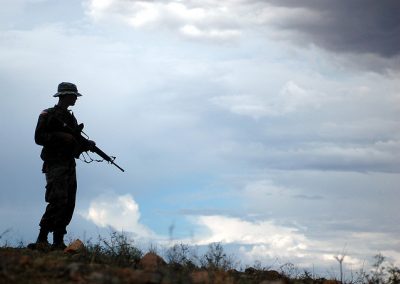
1,200 National Guard Troops to the Border: A Bargaining Chip or More Political Pandering?
Yesterday, President Obama met with Senate Republicans to discuss, among other things, moving forward with comprehensive immigration reform. But what came out of the meeting was a letter to Senator Carl Levin, Chairman of the Armed Services Committee, requesting 1,200 troops to be sent to the U.S.-Mexican border and a $500 million request for additional border personnel and technology as part of the Emergency Supplemental Appropriations Bill. While the President’s intentions to address the real sources of violence and crime along the border—that is, drug cartels and gun traffickers, not immigrants—is duly noted, the President is being perceived as piling enforcement on enforcement and pandering to Republicans with no real forward movement on reform. Read More
All gifts are matched dollar for dollar up to $75,000
No one should face the immigration system alone