 The American Immigration Council is a non-profit, non-partisan organization.
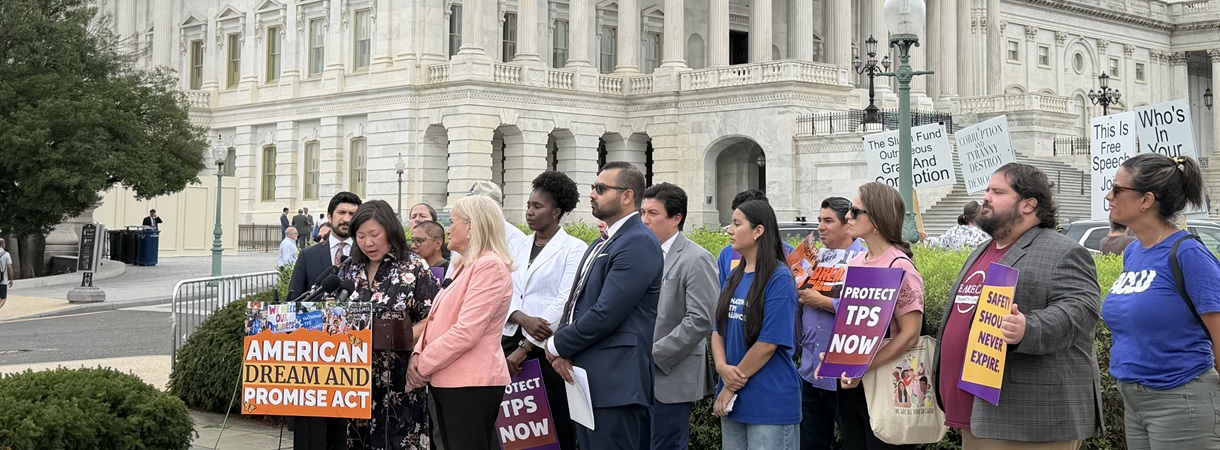
 Congress has a chance to take steps to protect hundreds of thousands of immigrants who are facing the likely prospect of job loss, arrest, and deportation after a Supreme Court decision last month empowered the Trump administration to dissolve the critical protections for nearly any reason. Beginning July 20, members of the U.S. House of Representatives can support a petition that would force a vote on the Dream and Promise Act, a bill that would provide millions of people with liminal immigration protections a path to permanent status.
Congressional action is more urgent than ever before given that the Trump administration is embarking on the largest de-legalization effort in U.S. immigration history. This has included stripping legal protections like Temporary Protected Status (TPS) from long-time immigrant residents and subjecting them to mass deportation. The Dream and Promise Act would offer protections and permanent status for people with TPS as well as most undocumented people who entered the country as children (known as Dreamers), recipients of Deferred Action for Childhood Arrivals (DACA), and those with a protection known as Deferred Enforcement Departure (DED).
Announced in 2012, DACA is an agency policy that provides certain undocumented youth protection from deportation and access to work authorization. For 14 years, the initiative has provided critical protections for hundreds of thousands of its beneficiaries while receiving overwhelming public support. However, since 2025, the Trump administration has detained and deported over 260 DACA recipients, in addition to pursuing several strategies to dismantle the long-standing policy through the federal courts.
Simultaneously, the administration has stripped TPS from nearly a million people — many of whom have called the U.S. home for decades — causing them to lose work authorization and face the prospect of deportation. Created by Congress in 1990, TPS offers work authorization and protection from deportation for nationals who would face dire humanitarian conditions such as war or national disasters if they returned to their country of origin.
A recent Supreme Court decision cleared the way for the Trump administration to follow through on its effort to terminate TPS for Syrians and Haitians. This places hundreds of thousands of law-abiding immigrants — including roughly 350,000 Haitian nationals fleeing an extreme humanitarian crisis — in immediate danger of job loss, family separation, and deportation. Given the Court’s decision, most other TPS holders including those from South Sudan, El Salvador, and Ethiopia are also at high risk of these same consequences.
How does the Dream and Promise Act protect Dreamers and TPS holders?
First introduced in 2021, the bill proposes two separate processes that would give Dreamers, TPS, and DED holders paths to permanent status.
For Dreamers, the bill proposes a two-step process: first, it offers them access to a 10-year “conditional permanent status;” later, it allows them to qualify for permanent status if they meet additional requirements. Dreamers are eligible for this two-step process if they entered the U.S. before they turned 18 years old, arrived in the country before January 21, 2021, have been enrolled in high school or an equivalent program, and do not have a conviction for certain serious offenses. Then, if they complete at least two years of college or military service or work for a three-year period, they would qualify for lawful permanent status.
For TPS and DED holders, the bill provides a more direct route to lawful permanent status. TPS holders (or those eligible for TPS on July 1, 2024, or individuals eligible for DED on January 1, 2017) can apply for lawful permanent status within three years of the enactment of the bill, if they have three years of physical presence in the U.S. and clear a background check.
How would the Dream and Promise Act impact American communities and the economy?
Dreamers andTPS holders work in essential industries, pay taxes, start businesses, buy homes, and support local economies. In 2023 alone, TPS holders contributed more than $5.2 billion in taxes and held $16.9 billion in spending power. In 2023, DACA-eligible people paid $11.5 billion in taxes and held $35 billion in spending power. Without congressional action, not only do families face separation, but employers face sudden workforce losses and local communities face unnecessary instability.
States with large communities of TPS and DACA recipients will feel these impacts more heavily. In Florida, over 150,000 Haitian TPS holders contribute $2.6 billion to the state’s economy and fill nearly 100,000 jobs, particularly in the hospitality, agriculture, and healthcare sectors. Similarly, in Ohio, TPS holders make up significant portions of the elder caretaking industry. Their critical role in local state economies has led Republican Governor Mike DeWine to repeatedly condemn the administration’s efforts to strip people of TPS. The Dream and Promise Act would make millions of workers across the country eligible for permanent status and increase their workforce participation.
What are the chances that the Dream and Promise Act will become law?
In the short term, the chances are low; but if the House of Representatives passes the Dream and Promise Act now, it may increase the likelihood that paths to permanent status for these vulnerable groups of people will become a reality in years to come.
Usually, the party in power in Congress has the authority to decide which bills come to the floor of Congress for a full vote. However, a “discharge petition” allows any member of Congress to force a vote on a bill if they can garner 218 signatures in support of the petition. With over 210 House members already supporting the Dream and Promise Act discharge petition, a small group of congressional members from both political parties will be the deciding factor in whether a petition forces the bill to a final vote.
Passage of the Dream and Promise Act in the House of Representatives would serve as a powerful antidote to the Trump administration’s mass deportation agenda, reminding Americans that paths to permanent status and citizenship for TPS holders and Dreamers can garner a broad coalition of support. Poll after poll show that most Americans support paths to citizenship for law-abiding and long-time immigrant residents. The Dream and Promise Act could finally be the bill that brings that political consensus to fruition — if Congress acts now.