U.S. immigration enforcement agencies use a range of programs to deport—or remove—certain noncitizens from the United States. During the first Trump administration, the Department of Homeland Security (DHS) and two of its component agencies, U.S. Customs and Border Protection (CBP) and U.S. Immigration and Customs Enforcement (ICE) worked to expand their existing pathways to rapidly remove noncitizens from the country. One method, the Electronic Nationality Verification (ENV) program, was touted as a way to expedite the repatriation of certain Central Americans.
The ENV program allows immigration authorities to verify a migrant’s country of origin through biometric information-sharing programs. The program allows ICE to identify and rapidly deport migrants from participating countries by eliminating the requirement for the issuance of paper travel document prior to removal. There is little public information about the ENV program—only fleeting references by officials or in obscure reports. Yet since 2019, the government has used ENV to rapidly deport thousands of people. This fact sheet describes the ENV program, whom it affects, and highlights concerns regarding the program.
Background
In order to repatriate a foreign national who has been ordered removed from the United States, ICE generally needs a valid unexpired passport or other travel document issued by an embassy or consulate to schedule and facilitate the noncitizen’s departure from the United States. If an individual from a participating country does not have a valid passport from their home country, ICE must contact the individual’s consulate to verify their nationality, as well as to obtain formal travel documents to execute their removal. Established in 2006, the “electronic Travel Document (eTD)” allows ICE personnel to request travel documents for migrants ordered removed, and for foreign consular officials to review and adjudicate them electronically rather than by mail. DHS claimed that the eTD system contributed to more expeditious removals and reduced the time individuals spent in detention by reducing the need to directly contact the consulate. According to DHS, Central American migrants face significantly longer average lengths of stay (ALOS) in detention than other nationalities. This is partially due to the fact that obtaining travel documents required for removal for these nationalities takes longer to acquire than other countries. With eTD in operation, DHS then created the ENV program and applied it to certain Central American countries to quickly verify an individual’s nationality through electronic verification and expeditiously remove migrants without proper travel documents from the United States.
What is the Electronic Nationality Verification Program?
The ENV program aims to create an even more streamlined process for removing migrants who lack appropriate documentation.i Under the ENV program, CBP coordinates with ICE Enforcement and Removal Operations (ERO) to “remove eligible [individuals] with final orders of removal to their native countries.” This means that if a migrant encountered by immigration authorities received an order of removal but does not have a valid passport or travel documents, CBP can verify their nationality electronically rather than waiting for the consulate to do so. Agencies can then rapidly remove nationals of participating countries. Under ENV, not only are travel documents produced electronically, but a person’s nationality is verified electronically, sometimes through the use of biometric identifiers. The ENV program allegedly reduces detention times by avoiding the “outdated, traditional process” of submitting paper travel document requests, waiting for consulars to issue physical travel documents, and awaiting arrival of these documents. In December 2024, ICE noted a 90.4 percent increase in ERO removals between fiscal years 2023 and 2024, and attributed this to several factors in FY 2024 including “reduced manifest notification requirements stemming from FY 2023 Electronic Nationality Verification (ENV) program.”
Origins of the Electronic Nationality Verification Program.
A pre-existing program with Mexico provided the framework for ENV. The Interior Repatriation Initiative (IRI) was a joint initiative that ERO piloted with Mexico in 2012 and later made it a permanent program. ICE advertised IRI as an initiative that allowed for “humane, safe, and orderly repatriation” of Mexican nationals. Using this framework, in July 2019, ICE initiated a five-week pilot ENV program with Guatemala, Honduras, and El Salvador to “expeditiously return” certain nationals to their home countries. On August 5, 2019, ICE made ENV a permanent program; and DHS announced in September that year that it was expanding the program.
Which Countries Participate in the ENV Program?
Implementation and expansion of the ENV program requires bilateral cooperation between the United States and participating nations. As of 2025, there are four confirmed countries participating in ENV: El Salvador, Guatemala, Honduras, and Peru.
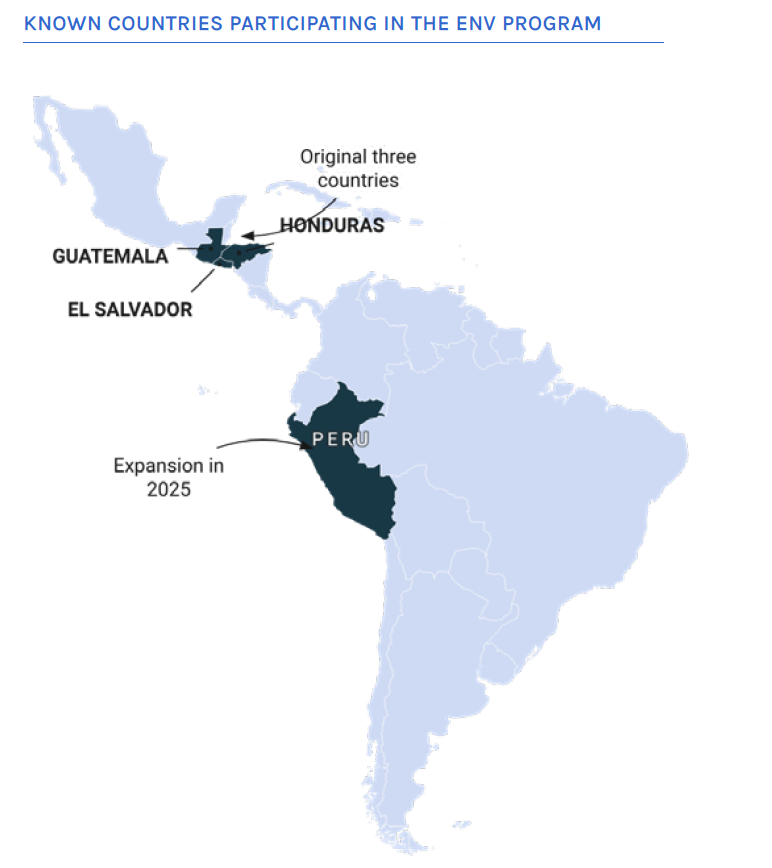
DHS has repeatedly announced plans to expand ENV to other countries. For example, in September 2023, ICE informed members of Congress that it was working closely with the Department of State to expand this program to other participating countries. However, ICE’s Annual Report, published in December 2024, did not mention any other country participating in ENV besides the original three countries. A DHS document obtained through a Freedom of Information Act (FOIA) request showed that in August 2021, ICE requested that the Ministry of Foreign Affairs in Brazil agree to a pilot test for the ENV program. However, no public documents exist confirming that Brazil agreed to pilot this test. The only confirmed expansion of ENV took place in April 2025 when the Bureau of Western Hemisphere Affairs publicly announced via the social media platform X that Peru had agreed to adopt the ENV program.
Who is Eligible for the ENV Program?
A 2019 memo titled the “Prioritization of Removal Pathways” obtained as a response to a FOIA request details the “broad suite of immigration pathways available” to immigration enforcement agencies to “address the migration crisis along the Southwest Border.” The memo expands upon the primary pathways used to remove migrants in order of general priority, which included ENV at the top.
Single Adults and Family Units:
According to the memo, participating nations agree upon criteria of eligibility. An identification document (ID) is not required but would be preferred; and criminal history is not an excluding factor in participation. While families are eligible for participation, families “should not be separated for participation” in ENV. ICE ERO is directed to transport families together “as much as possible” in order to avoid stress separation. Minors who are part of a family unit will travel with at least one parent.”
General Requirements:
- Must be of a participating country
- Must have an executable final order of removal
- No legal impediments
- No other pending litigation
- No stay of removal
- No request for stay
Ineligible:
- Those who express fear of persecution or torture
- Pending credible fear claims —meaning people seeking asylum or another form of humanitarian relief.
Unaccompanied Children:
Initially, unaccompanied children (UAC) were ineligible for participation in ENV.ii However, in 2021 ICE ERO extended ENV to children in proceedings under § 240 of the Immigration and Nationality Act from Guatemala, Honduras, and El Salvador.iii The 2021 Juvenile Coordinator Handbook issues general requirements for UAC eligibility in ENV, as well as country-specific requirements for participating nations. No public guidance exists on UAC eligibility for Peru.
General Requirements:
- Affirmative claim to citizenshipiv
- Executable final order of removal
Ineligibility:
- High-profile removals
- Cases with dual nationalities
- Cases where nationality is in question
- Case with medical concerns should be cleared by IAO prior to scheduling removal
- Any other cases of interest that is not deemed routine
Country Specific Requirements:
| Guatemala | Honduras | El Salvador | |
| Minimum Age | 14 years or older | 13 years or older | Any age |
| Medical Concerns | Must have no medical concerns. | Medical concerns are not an excluding factor. | Must have no medical concerns. |
| Additional documents required | Copy of charging document, final order of removal, and photo. | Case must reflect city and state of residence upon return. | Serviced copy of the Orantes rights must be included in the A-file. |
ENV Process
The 2019 DHS memo on the Prioritization of Removal Pathways established ENV countries and described some procedures and terms for the program but failed to provide additional details or definitions. The known process includes the following steps: U.S. Border Patrol (USBP)—a component of CBP—works with ICE ERO to remove individuals encountered at or near the border who may be subject to the ENV program.
- USBP identifies detained individuals apprehended at or near the border who are eligible for ENV. Agents process and hold individuals referred to the program at a USBP location designated an ENV “Processing Spoke.”
- During processing, officers are supposed to verify eligibility, documents, and follow “consular notification procedures”—which are not specified.
- After processing, USBP arranges for transportation of the removable individuals, their property, and their “A-files” (the government’s immigration file on each person) to an ENV “Removal Hub.” The Removal Hub is a regional USBP location serving as the “transfer recipient, processing facility, and removal facility” for the ENV program.
- USBP agents at the “Removal Hub” are responsible for coordinating daily with the ERO field office to provide a list of individuals for deportation. The USBP officials are tasked with completing and verifying an I-216 form (Record of Persons and Property Transferred), along with any other removal processing documents.
- The local ERO Field Office communicates with ICE Air Operations to coordinate and schedule flights. The USBP “Removal Hub” is responsible for coordinating transportation to the flight location.
- The Processing Spoke or Removal Hub must also notify the appropriate consulate. ICE ERO is supposed to receive flight manifests including Guatemalans or Salvadorans in advance for “country clearance,” though it is not clear what that involves.
- In some instances, the Processing Spoke and Removal Hub may be located together, further expediting the process.
- ICE does not require individuals in ENV to have a full medical screening. The guidance states that “a cursory screening” will be provided for “identifiable complex medical conditions.” For “new arrivals”—individuals who have had no screening and for which there is no medical information available—the ICE “Air Flight Medical Provider” is to conduct a “visual screening” on the flight.
- ENV guidance states that families should not be separated. ICE ERO is directed to transport families together “as much as possible in order to avoid stress separation. Minors who are part of a family unit will travel with at least one parent.”
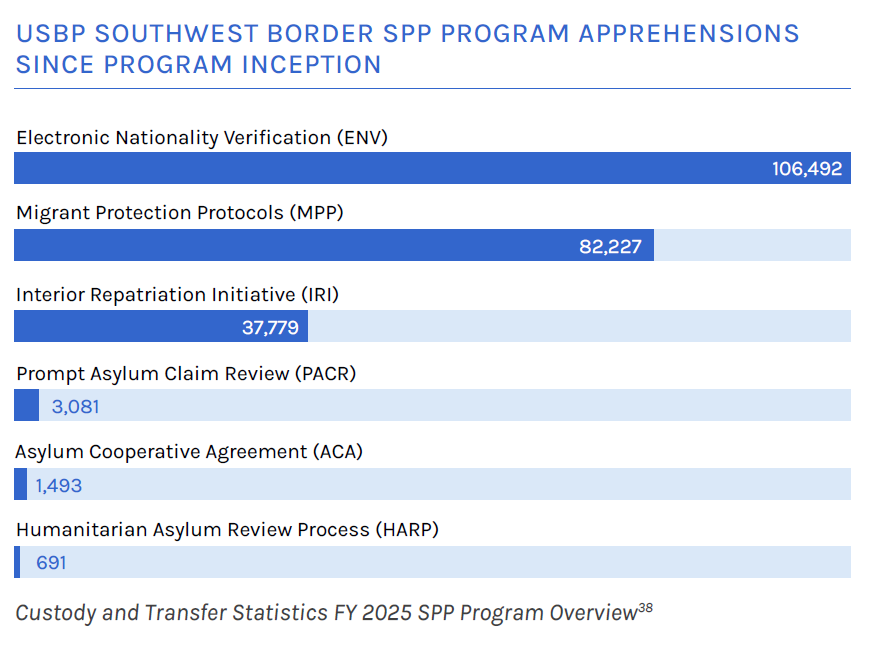
The Custody and Transfer Statistics page highlights the Southwest Border Pathway and Programs (SPP)—the five main pathways immigration enforcement agencies have used to remove noncitizens from the country. According to public data, the ENV Program had the most apprehensions compared to any other SPP Program with 106,494 occurring since the program’s inception in August 2019. This aggregate number does not include data from the five-week pilot program between July and August 2019.
SPP Program Overview
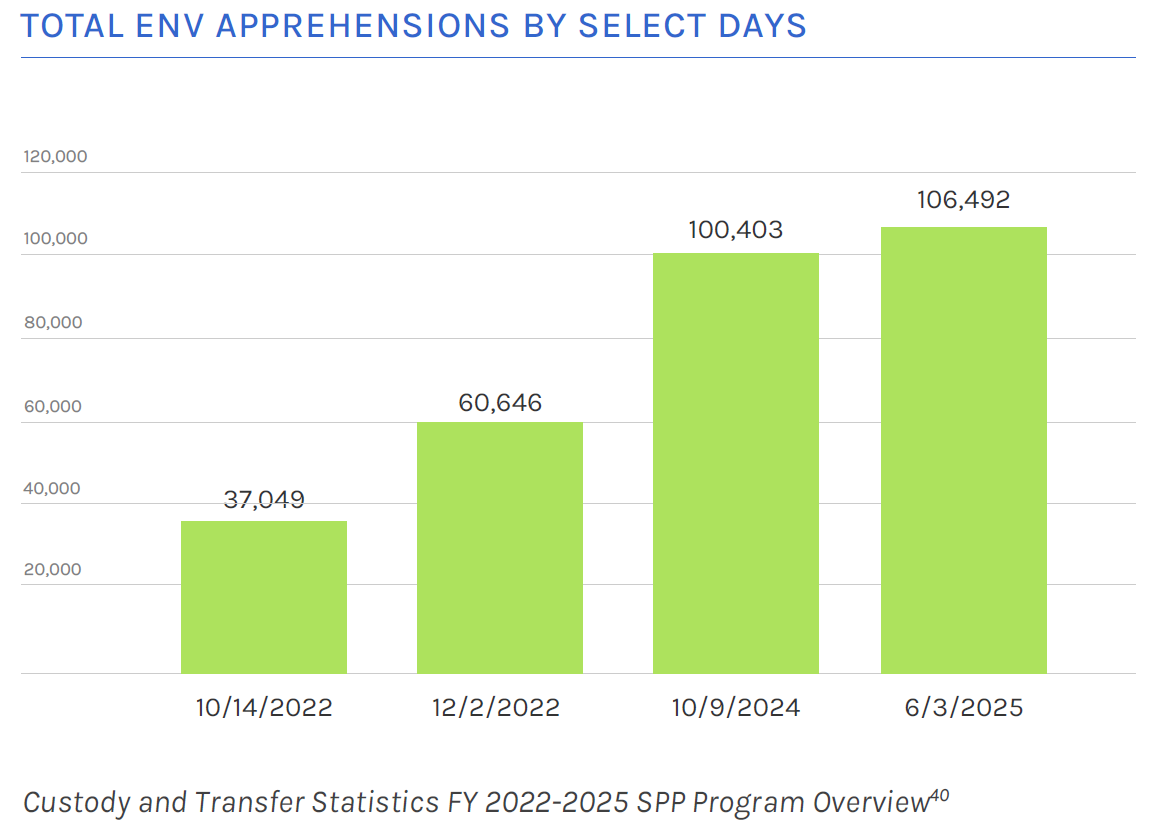
Data on the Custody and Transfer Statistics page from fiscal years 2022-2025 shows the total apprehensions that have occurred through the ENV program by four select days. The data over time shows a steady increase in apprehensions between October 14, 2022, and December 2, 2022, with 23,597 having occurred in this time frame. There was an even larger increase in apprehensions between December 2, 2022, and October 9, 2024, with 39,757 apprehensions occurring in this time period. However, apprehensions drastically decreased in fiscal year 2025 with only 6,089 apprehensions having occurred between October 9, 2024, and June 3, 2025.
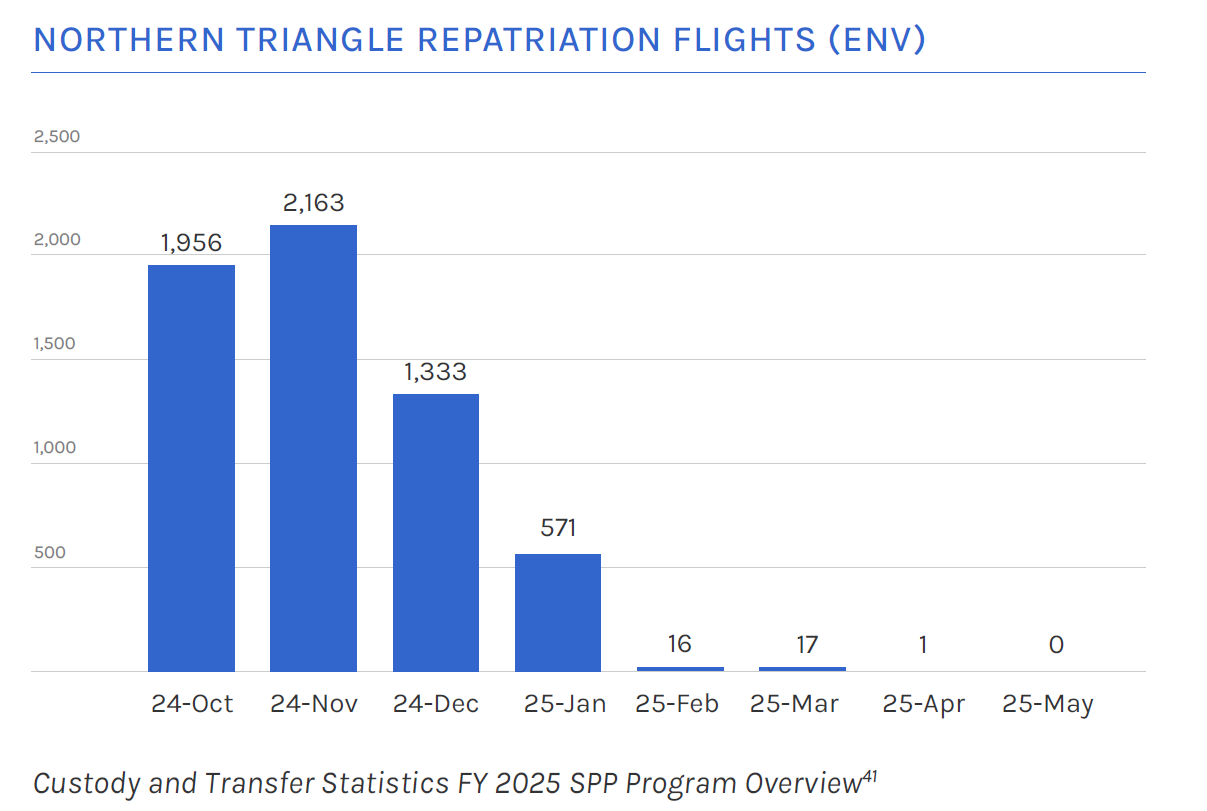 The Custody and Transfer Statistics page shows limited information on the total apprehensions by transfer destination through ENV on a month-by-month basis. According to the data, there have been 6,057 apprehensions from October 2024 to May 2025. However, there has been a drastic decrease in apprehensions through ENV from November 2024 to January 2025. Only 34 apprehensions have occurred between February 2025 to May 2025 with no apprehensions occurring in May 2025. The drop in ENV apprehensions is likely due to the overall drop in Southwest Land Border Encounters beginning at the end of 2024, and plummeting to historic lows beginning in February 2025.
Concerns About the Electronic Nationality Verification Program
DHS describes the ENV program as one of the most “effective and lasting” pathways for removal. Yet, the government has provided very little public information about the program.
The lack of information about a program that has resulted in thousands of removals since 2019 raises questions about due process. Other programs designed to expedite removals severely limited, or effectively barred, access to asylum for those seeking refuge at our borders. Shortened processes can increase the likelihood of erroneous removals and rush the complex process of individuals expressing their fear of persecution if returned to their home countries. Moreover, there is little to no information about how DHS involves consulates when placing a foreign national in ENV.
The rapid process of deportations also makes it more difficult for attorneys or advocates to access individuals prior to their removal, which could increase the possibility of erroneous removals. More information is necessary to determine the effect of ENV on asylum seekers. While some portions of the DHS memo remain unredacted, it appears that there is no guidance speaking to situations where a person expresses a fear of persecution during the ENV process. This is particularly important given the well-documented failure of CBP officers to properly screen asylum seekers in all cases.
The ENV program also seems to encourage immigration agencies to prioritize the removal of eligible noncitizens from detention centers with the highest populations. The emphasis on limiting the use of detention space, rather than assessing the strength of a person’s case for relief from removal, raises further questions around due process protections and the fairness of this program. Detention space and overcrowding are serious issues, but individuals must have due process in their cases, especially when claiming fear. DHS maintains broad discretion to release individuals in its custody. The agency’s choice to use detention should not affect due process.
Years after its implementation, and even after its recent expansion, DHS has yet to provide public information about the operation of the ENV program and similar initiatives for fast-track deportations. The government should ensure that sufficient safeguards are put in place to address these concerns.