Key Takeaways
- Records show the agencies in charge of record-keeping did not have systems in place to track separated children.
- The data that agencies collected contained inconsistent and missing information.
- The agencies in charge of implementing family separation lacked intra-agency protocols, which impeded communication among agencies.
The tranche of FOIA records reveals serious difficulties in government record-keeping around family separation. The documents show that agencies’ challenges in compiling data were not simply due to an erroneous database complication but to Border Patrol’s own flawed record-keeping. As a result, hundreds of children were essentially lost in the system, with no way of reuniting them with their parents.
Issues in Record-Keeping Prior to Zero-Tolerance Policy
The FOIA records document a long history of improper record-keeping, even prior to the implementation of the zero-tolerance policy. An email exchange from November 21, 2017, between a Houston Chronicle reporter and an ICE officer shows a lack of protocol in separating families, a shortage of methods to document family separations, and database problems of which were not resolved prior to implementing the policy.
Lomi Kriel, the reporter who wrote the story but whose name is redacted from the government records, asked ICE for policy guidance on family unity and separation, specifically citing a report by LIRS, KIND and others that found a “lack of mechanism for tracking and recording family relations,” including an absence of shared databases among immigration enforcement agencies. The report indicated that there was not a government entity responsible for systematically tracking family separations, nor did agencies have a protocol for separating families.
In response, the officer said ICE made determinations “on an individualized basis considering the unique facts of each case,” and declined to elaborate on the status of families that the reporter had already identified.
Throughout 2017 and early 2018, organizations and members of Congress sought information from ICE about family separations. ICE officials continued to give general answers and confirmed the lack of a comprehensive system to track separated children.
BLANK, THOMAS
…regarding the number of families separated … ICE does not have the data due the few instances where this occurs. ICE ERO did poll the FODs. The Southwest border FODs (San Antonio, El Paso, Phoenix and San Diego) do not track or collect specific information on the release/separation of families so don’t have anything further to add. The separation of families is so infrequent that ICE has no records to support the few numbers of family units that have been separated due to officer discretion, as each case is determined on its merits. That said, the approximate number of family unit separations that ICE has determined within the recent fiscal year has been less than 10 cases at most per the leadership of ERO.
Records reveal that government agencies lacked protocols when separating families. While CBP indicated that it would separate in situations of “fraud, criminal prosecution, or humanitarian issues,” it also indicated that separations occurred “due to officer discretion, as each case [would be] determined on its merits.”
Officials knew of these deficiencies due to earlier, local pilot initiatives that separated family members. The DHS Office of Inspector General (OIG) reported that CBP “officials have been aware of … IT deficiencies [to track separated families] since at least November 2017” due to the El Paso Border Patrol’s practice of family separation at that time. The OIG found that, despite knowing about these problems, CBP did not address the deficiencies or offer training in advance of the implementation of the zero-tolerance policy. These failures led to difficulties in tracking and reuniting families after the policy ended.
Flimsy Record Keeping Under Zero-Tolerance Policy
Documents also point to numerous data issues, including missing and inconsistent records; a lack of communication between and across agencies; difficulties in pulling records from the database; and, most importantly, improper documentation by Border Patrol when encountering families. No standard procedure existed to track prosecutions of adults in family units, and no effort was made to centrally track separations. Most tracking occurred on an Excel spreadsheet or through daily emails.
“Consistency in reporting and data integrity are crucial for the correct reporting to USBP HQ. Please ensure that the attached spreadsheet is completed daily (Excel spreadsheet). Each station must submit their spreadsheet by COB following PAIC review to BBT Operations. I know the additional reporting is not fail-proof, however, until a SharePoint reporting method is established, we will have to continue to report the numbers via daily emails. As we receive additional information regarding reporting requirements, we will send it to the stations immediately.”
Government agencies did not have a central prosecution database nor did they have a standardized method for tracking prosecutions over time. Individual agencies used spreadsheets inconsistently, and they lacked a procedure for documenting prosecutions. Border Patrol agents did not have a standard method to track separations. The resulting haphazard methodology—using individual spreadsheets and email exchanges to document separations—led to errors in identifying parent-child relationships and delays in reunification.
Data Integrity Issues Come to Light after Zero-Tolerance Policy Ends
In November 2019, a DHS OIG report found that DHS lacked the proper technology to track separated families. The report concluded that DHS failed to provide adequate guidance to personnel responsible for executing the zero-tolerance policy, and that CBP adopted various “ad hoc methods” to record and track family separations, introducing widespread errors in data-keeping.
Inconsistent and Missing Records
Soon after the zero-tolerance policy ended, ICE officials began to notice discrepancies in Border Patrol data pertaining to families separated at the border, including inconsistent and missing records. When members of Congress asked agency officials to produce numbers on family reunifications, the agency staff had difficulty matching children with their parents, were missing records for children in HHS custody, and had inconsistent statistics.
REDACTED
HHS had a list of 50 kids they were having difficulty matching with parents.
Lynch, Jeffrey D
Great, five with no location information. Check with HHS to see if they have info.
Hoffman, Jonathon
Do you mean five kids with no location info?
Lynch, Jeffrey D
Yeah, there is no book in information on the spreadsheet.
REDACTED
We will add the info as needed on the combined spreadsheet.
Albence, Matthew
Please hold. These numbers don’t appear to mesh.
At one point, an ICE officer noted significant “data quality” challenges with the Border Patrol data, and senior ICE official at the time, Nathalie Asher, admitted that the data was “corrupt.”
Inadequate Data-Keeping by Border Patrol Officers
An investigation by ICE Office of Field Operations (OFO) into systemic issues showed that the databases were not capturing all instances of separation, and were thus “underreporting” instances of family separation. The underreporting was due to Border Patrol agents’ poor practices in documenting separations. Border Patrol officials would apprehend children and adults arriving together at the border as a family but document them individually as a “single adult” or “unaccompanied child” and proceed with the prosecution of adults in family units.
The data visuals below show the discrepancies in Border Patrol record-keeping. The family status column documented individuals as single adults or unaccompanied children but also listed them as a separated family unit.
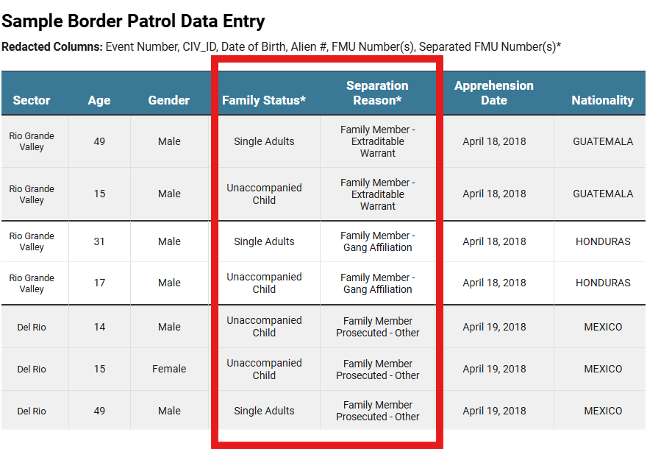
When reviewing Border Patrol data on separations, ICE official Nathalie Asher at one point explicitly stated that her confidence in the reported numbers was very low.
Albence, Matthew
These numbers are going to be released tomorrow. What do we have any level of confidence in?
Asher, Nathalie
At this point for me…not very much.
I also notice the HHS stats below are supposedly ZTP only, while we refer to “the class” stats, which includes cases pre ZTP…not sure if they are one in the same.
Even after accounting for this Border Patrol practice, CBP continued to discover errors and additional separations weeks after the zero-tolerance policy had concluded.
A key dataset in the records is a spreadsheet that shows Border Patrol’s nationwide apprehensions, covering fiscal year 2018 and the first month of fiscal year 2019. The visuals below highlight many of the integrity issues documented in this dataset.
Lack of Communication Between and Among Agencies
The records show that government agencies such as ICE and HHS failed to define key terms, leading to inconsistent productions of statistics when pulling data from the database, and general confusion regarding the total number of children separated. For example, in a July 5, 2018, email exchange between ICE and CBP staff members, Matthew Albence calls out HHS for discrepancies in the available data on separated families, stating that ICE had identified 22 separated children, 14 of whom were under the age of 5, but that HHS had documented nearly five times that number.
Albence, Matthew
There seems to be a fundamental lack of communication up and down the HHS chain.
REDACTED
HHS is at about 101 children under 5 that are in their care that they consider to be separated, our number that were separated under ZTP is 22. We cannot be off by a factor of 5 without having a fundamental difference of definition of which UACs are appropriate to include. One difference that is clear to me is they are including children that were placed in HHS care dating back to March, our counting I believe starts with the implementation of zero tolerance policy.
Border Patrol’s own entries confirm the inconsistency between its and HHS’ numbers. Border Patrol data lists over 3,000 children under the age of 17 as separated from a family unit. This includes 106 children under the age of 5.
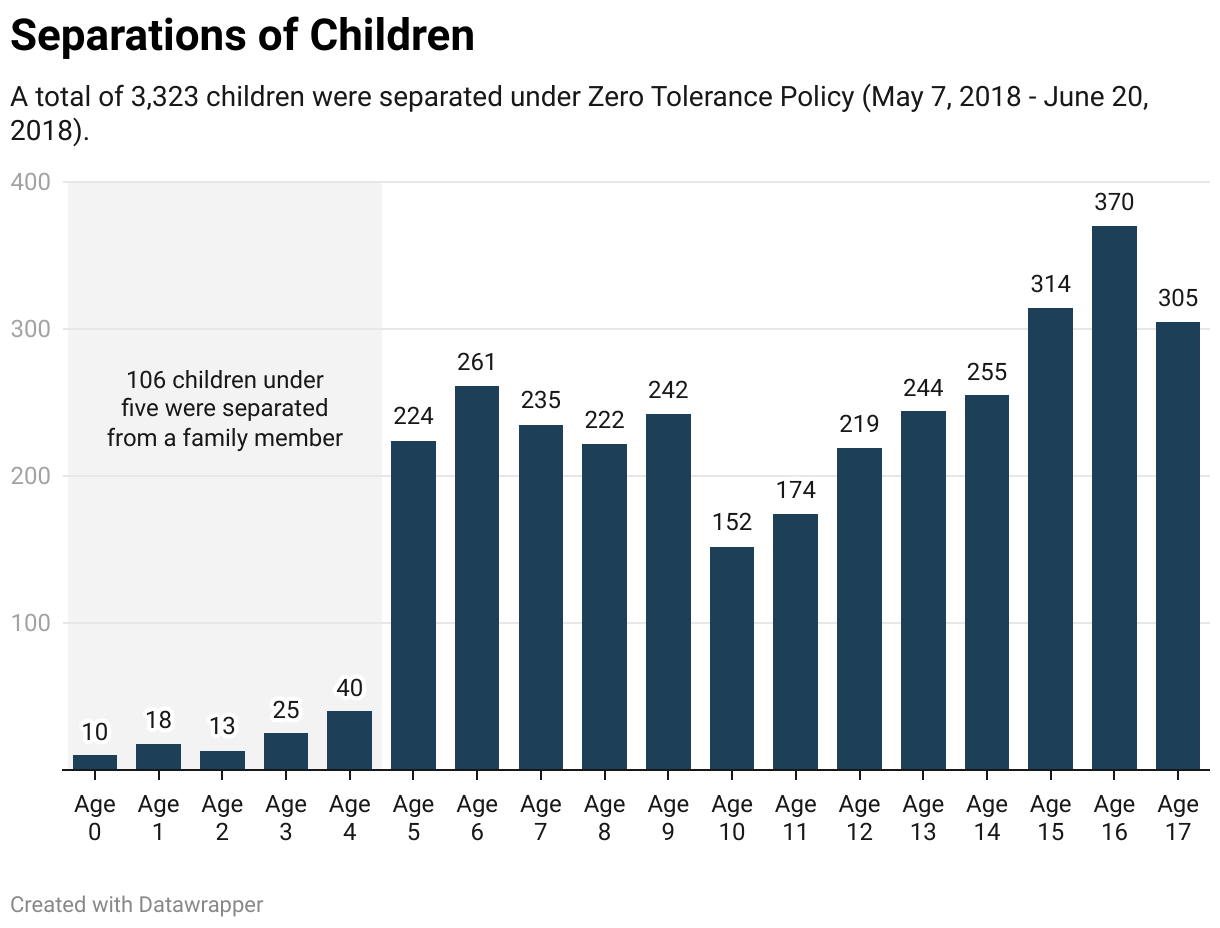
The email exchange between ICE and CBP staff members also demonstrates how inadequate communication existed within HHS in reporting numbers and going through separated child and parent case records. Discrepancies also appeared to exist in how the family separation policy was being implemented.
Efforts by government officials to parse the data also revealed discrepancies in how the policy was being implemented to begin with – implying a lack of communication and coordination between government agencies when separating families. In an email exchange between USBP Executive Assistant Commissioner Todd Owen and Acting U.S. Secretary of Homeland Security Kevin McAleenan, Owen notes that the proportional change in the difference/rate in numbers is due to the fact that 85 percent of separations were in the Laredo Office, which was separating “liberally at a much higher rate,” and that this inevitably “served to skew the data.”
DHS failed to implement a uniform procedure for separating families across sectors. As a result, certain field offices separated families at drastically higher rates than others.
As the document show, there were a multitude of logistical issues regarding family separation prior to the implementation of zero-tolerance policy. ICE claimed that it did not track separations because separations were “rare” prior to the implementation of the policy. Furthermore, there was a lack of protocol in separating families – justified by government agencies’ claims that family separations occurred under the “discretion” of officers. Many of these issues came to light after the zero-tolerance policy ended. The lack of protocol, inadequate inter-agency communication, and poor record-keeping exacerbated many of the inherent issues with forcibly separating children from their parents. Government agencies had distinct IT systems that did not communicate with each other, and Border Patrol incorrectly labeled many of these families leading to significant delays in reunification. In some cases, families were never reunified.