
Due to the coronavirus outbreak, millions of students face severe challenges as they transition to remote learning. At every level, from daycare centers and preschools all the way up to colleges and universities, immigrants in the U.S. education sector play a significant role in supporting children and their families. Together, they help ensure America’s next generation receives the quality education they need during the Covid-19 crisis and beyond.
The latest data from the American Community Survey show that 2 million immigrants made up more than one in eight workers in the U.S. education sector in 2018. Nearly 60 percent of these immigrant workers held a bachelor’s degree or higher.
Figure 1: Immigrants in the Education Sector Source: NAE Analysis of 1-year sample from the 2018 American Community Survey
Number of Foreign-Born Workers
Share of All Workers, Foreign-Born
Education Sector, Overall
2,056,041
12.8%
Child Day care
278,313
17.7%
K-12
898,365
9.8%
Colleges and Universities
750,415
17.3%
Others Schools and Education Support Services
128,948
14.0%
In the 15 largest states by population, immigrants make up at least one out of every seven workers in education. In some states, that share is even higher. For example, in New York, California, and Florida, immigrants make up more than one in five workers in this sector.
Figure 2: Immigrant Workers in the Education Sector in the 15 Largest States Source: NAE Analysis of 1-year sample from the 2018 American Community Survey
State
Number of Foreign-Born Workers
Share of All Workers, Foreign-Born
New York
242,521
20.0%
New Jersey
98,841
19.6%
California
393,391
22.4%
Michigan
34,353
7.8%
Massachusetts
74,919
16.3%
Florida
168,876
20.7%
Illinois
78,306
11.9%
Washington
42,860
12.4%
Pennsylvania
51,417
7.9%
Texas
234,691
16.8%
Virginia
66,431
14.4%
Georgia
47,326
9.6%
Arizona
40,767
13.0%
North Carolina
37,333
7.7%
Ohio
30,922
5.8%
Nationwide, more than 278,000 immigrants make up 17.7 percent of all workers at childcare centers. These immigrant workers help take care of children of essential workers who fight on the frontlines. Many now also work with parents at home to continue nurturing children’s early development through online activities.
Figure 3: Immigrant Workers in Child Day Care Source: NAE Analysis of 1-year sample from the 2018 American Community Survey
Number of Foreign-Born Workers
Share of All Workers, Foreign-Born
United States
278,313
17.7%
New York
46,810
37.0%
New Jersey
15,484
33.9%
California
62,401
37.2%
Florida
23,275
28.3%
Illinois
10,511
16.9%
Texas
21,952
17.5%
Virginia
11,513
25.7%
From socially distant play to virtual storytime, childcare workers and teachers have quickly restructured their programs to ensure children’s safety and to help them adjust to the new learning environment. About one in five childcare workers and one in eight preschool teachers are immigrants.
Figure 4: Select Occupations in Child Day Care in the United States Source: NAE Analysis of 1-year sample from the 2018 American Community Survey
Occupation
Number of Immigrant Workers
Immigrants’ Share of Workforce
Childcare Workers
157,776
21.7%
Preschool Teachers
58,506
12.3%
Teaching Assistants
21,324
19.7%
As millions of students in the K-12 system struggle to cope with major disruptions at school and at home, immigrants, along with their U.S.-born colleagues, help provide the stability students need at a time of crisis. In primary and secondary education, nearly 900,000 immigrants make up almost one in 10 workers nationwide. In California alone, one in five workers in the K-12 system are immigrants.
Figure 5: Immigrant Workers in Primary and Secondary Education Source: NAE Analysis of 1-year sample from the 2018 American Community Survey
Number of Foreign-Born Workers
Share of All Workers, Foreign-Born
United States
898,365
9.8%
New York
111,010
15.6%
New Jersey
49,174
14.9%
California
194,480
19.8%
Massachusetts
20,677
9.4%
Florida
84,675
17.4%
Illinois
28,384
7.8%
Washington
14,314
7.4%
Pennsylvania
12,947
3.7%
Texas
139,405
15.4%
Virginia
28,127
10.9%
Georgia
18,988
6.4%
Arizona
20,974
11.5%
Maryland
20,087
11.2%
North Carolina
11,591
4.4%
While K-12 schools were already struggling to recruit and retain teachers before the pandemic, immigrants play a critical role in easing the teacher shortage. Nearly one in 13 teachers in elementary, middle, and high schools are immigrants. During the crisis, they are working hard to develop online courses and help students progress through their learning milestones. Among them are also nearly 18,000 foreign-born special education teachers who work with students with special needs, making sure they will not fall behind during the lockdown.
Figure 6: Select Occupations in Primary and Secondary Education in the United States Source: NAE Analysis of 1-year sample from the 2018 American Community Survey
Occupation
Number of Immigrant Workers
Immigrants’ Share of Workforce
Elementary and Middle School Teachers
285,238
7.5%
Teaching Assistants
139,104
14.3%
Secondary School Teachers
55,107
7.4%
Special Education Teachers
17,877
7.3%
Meanwhile, colleges and universities are also tackling the sudden transition to online learning, with their immigrant staff members working hard to keep students connected and engaged in distance learning. More than 750,000 immigrants make up 17.3 percent of the higher education workforce.
Figure 7: Immigrant Workers in Colleges and Universities Source: NAE Analysis of 1-year sample from the 2018 American Community Survey
Number of Foreign-Born Workers
Share of All Workers, Foreign-Born
United States
750,415
17.3%
New York
70,009
23.2%
New Jersey
27,692
29.2%
California
104,968
22.6%
Michigan
21,477
13.8%
Massachusetts
40,320
22.9%
Florida
49,397
25.6%
Illinois
36,353
18.7%
Washington
16,151
17.5%
Pennsylvania
28,230
14.1%
Texas
63,704
21.4%
Virginia
21,133
16.1%
Georgia
20,196
16.9%
Arizona
13,636
16.6%
Maryland
21,339
19.6%
North Carolina
20,382
14.0%
As students try to figure out how to address challenges ranging from technical issues to distractions to lack of in-person interaction in online classes, they rely on their teachers and advisers for guidance and instructions, including the more than 370,000 immigrants working in such roles in higher education. In colleges and universities, more than one in five instructors and professors, one in four teaching assistants, and one in eight counselors and advisors are immigrants.
Figure 8: Select Occupations in Colleges and Universities in the United States Source: NAE Analysis of 1-year sample from the 2018 American Community Survey
Occupation
Number of Immigrant Workers
Immigrants’ Share of Workforce
Postsecondary Teachers
310,688
23.0%
Teaching Assistants
34,019
29.4%
Counselors and Advisors
14,707
12.3%
Tutors
13,937
18.5%
More than three-quarters of these immigrants working in higher education have at least a bachelor’s degree, and closely 60 percent have an advanced degree. They are passing on their expertise and experience to students who will soon become an essential part of the force to help the country recover and rebuild after Covid-19.
Figure 9: Educational Attainment of Workers in Colleges and Universities Source: NAE Analysis of 1-year sample from the 2018 American Community Survey
Share of U.S.-Born Workers
Share of Foreign-Born Workers
Bachelor’s Degree
24.6%
18.6%
Advanced Degree
40.8%
59.2%
Reimagining how schools should function in the middle of a pandemic is not an easy task. Still, immigrants in the education sector are helping schools think through the major challenges they face, ranging from issuing new health and safety protocols to offering online instructions, to make sure their students will stay safe, healthy, and educated during this unprecedented crisis.
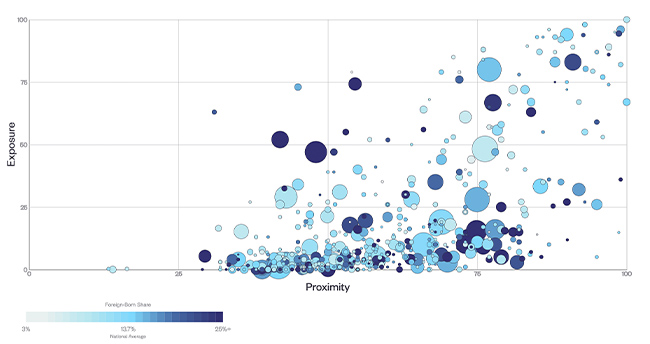
If you want to explore how immigrants often disproportionately serve in some of the most at-risk jobs in the Covid-19 crisis, including teachers and childcare workers featured in this brief, click the image below to explore our data visualization.
Finally, check out our research portal of Immigration and Covid-19. If you have any specific questions about our data, please reach out to us at [email protected].