
This research was funded in part by the Annie E. Casey Foundation and we thank them for their support; however, the findings and conclusions presented in this report are those of the authors alone, and do not necessarily reflect the opinions of the Foundation.
Executive Summary
Childcare is a cornerstone of economic stability in the United States, enabling millions of parents and guardians, particularly mothers, to participate in the workforce. Despite declining birthrates, the demand for childcare remains high: 18.6 million workers nationally have children under the age of 5, the age group most likely to require full-day care. Yet the sector faces persistent challenges that limit access for families, most notably high costs and staffing shortages expected to worsen in the years to come.
Immigrants are essential to sustaining the childcare workforce. Nationally, one in five childcare workers is an immigrant, with even higher concentrations in metropolitan areas such as San Jose and Miami. Compared with their U.S.-born counterparts, immigrant childcare workers are more likely to be older; to work full-time; and to be self-employed. They bring diverse educational backgrounds and cultural competencies that enrich children’s learning experiences and support working families.
However, mass deportation and restrictive visa policies are threatening the stability of this workforce. More than half of immigrant childcare workers are non-citizens, and nearly a third are undocumented. Enforcement actions in previously protected areas such as daycare centers, along with visa processing delays and revocations of work authorization, have disrupted childcare arrangements, forcing parents and guardians to reduce work hours, change jobs, or leave the workforce entirely, with ripple effects on American communities and businesses across the economy.
Key Findings
Demand for Childcare: 11.2 percent of the employed workforce in the United States of the employed workforce, or 18.6 million workers, are parents of young children (under the age of 5).
Workforce Participation: Labor force participation among mothers of young children rose from 66.2 percent in 2013 to 70.8 percent in 2023.
Impact on Employment: Due to childcare being unavailable or unaffordable, 12.8 million households with children under the age of 14, or 41.9 percent of those households, had at least one adult whose work was affected, including 2 million households with adults who cut their work hours and 1.3 million households with adults who did not look for a job.
Immigrant Workforce: 282,900 immigrants are employed as childcare workers, comprising 20.1 percent of the workforce; 97.6 percent of them are women. Immigrants make up 31.9 percent of childcare workers in private households, and 18.3 percent in childcare centers.
Workforce Profile: One in five immigrant childcare workers come from Mexico. Immigrant childcare workers overall are more likely to be self-employed, working full-time, and older than their U.S.-born counterparts. Over half are non-citizens, and many are vulnerable to enforcement actions.
Texas Spotlight: In Texas, 22,900 immigrants make up 19.2 percent of the state’s childcare workforce, with significant contributions in the Houston and Dallas metro areas.
Immigrant childcare workers are indispensable to the U.S. economy. They provide essential support to working families, especially in regions with limited childcare alternatives. Policies that destabilize this workforce undermine not only immigrant families but also a national economy that depends on parents’ ability to work.
Working Parents and the Demand for Childcare
Demand for childcare remains strong in the United States, even as people choose smaller families or postpone having children—factors that have contributed to declining birth rates in recent years.
Nationally, 18.6 million workers, or 11.2 percent of the employed workforce, have children under the age of 5, the age group most likely to require full-day care.1 The childcare sector, which already faces staffing shortages and rising costs, provides essential services that enable parents to stay employed and businesses to retain workers.2
“Societies can’t function without children who are taken care of,” said Elizabeth Cummins Muñoz, a U.S. Hispanic and women’s studies scholar and author of Mothercoin: The Stories of Immigrant Nannies. “We have been taught to understand that reproductive labor is outside of the economy. But it’s not.”3
Parents with young children, especially mothers, are participating in the labor force at higher rates than they were a decade ago. Between 2013 and 2023, the labor force participation rate of women with young children rose from 66.2 percent to 70.8 percent.
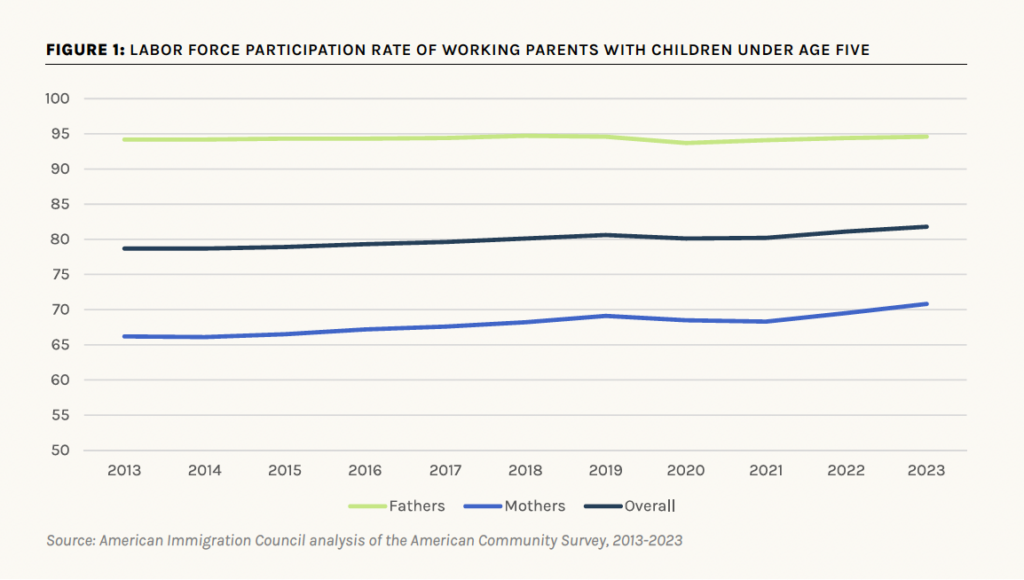
The share of young children without a stay-at-home parent also increased, from 52.0 percent in 2013 to 60.1 percent by 2023. In some metro areas, the share is even higher. In Portland, Maine, and Madison, Wisconsin, three out of four children live in households where all parents work.
“It is a shadow industry that we rely on,” Muñoz said of the childcare sector. “It enables cultures of motherhood that would otherwise be unsustainable, because our culture of work and standards of motherhood have risen, as well as the economic demands on the family.”4
Immigrant Nannies Make Work Possible for a New York Family
Liz, a fourth-generation New Yorker, found her family’s first nanny through a neighborhood parent group, and their second through a nanny co-operative. Both were immigrants, simply because, as Liz put it, “the bulk of nannies who are working in Brooklyn are immigrants.” Liz works in child welfare and philanthropy, and her husband is a medical researcher. “I want to be working,” Liz said. “If I didn’t have somebody who I thought was safe and caring and aligned with my kids every day then I wouldn’t be working.”
Read the StoryLack of Access to Affordable Childcare
In 2023, there were 18.3 million children in America under the age of 5, needing full-day care provided by their parents, through their family, friend, and neighbor (FFN) networks, or by the 1.4 million childcare workers employed nationally. Some parents have to forego employment opportunities because they can’t secure reliable childcare through their FFN networks or find affordable childcare services.
A Childcare Crisis
The cost of childcare services remains prohibitive for many families in the United States. Data from the National Database of Childcare Prices (NDCP) at the U.S. Department of Labor shows that in 2022, families spent between 8.9 and 16 percent of their county’s median income on full-day childcare for just one child, with the median costs in U.S. counties ranging from $6,552 to $15,600 annually, depending on county size, the age of the child, and the type of care (center-based or home-based).8 In comparison, the national median annual rent was $16,085 that year.9
The most expensive forms of childcare often exceed what families can afford. The Department of Health and Human Services sets the benchmark for “affordable childcare” at 7 percent of family income. In 96.8 percent of counties, the median cost of full-day center-based care for infants (generally the most expensive type) exceeds that threshold for a family earning that county’s median income.10 11
Supporting Working Families Through Flexible, Affordable Childcare
KidsPark strives to support low- and middle-income parents, for whom standard childcare can be prohibitively expensive—potentially pushing them out of the workforce for years. And, from the beginning, immigrants have been vital. “We’ve always relied in the childcare industry on people who have come here from another country, or are first- or second-generation,” said Heather Alanis, who owns the center with her sister, Beth Christie. “We have, over the years, hired cousins and sisters because we believe they work so well together, and all of them have come from immigrant families,” said Beth.
Read the StoryChallenges for Working Parents
A lack of reliable childcare affects the ability of many working parents to meet their employers’ needs and to earn enough to support their families. According to the 2023 National Survey of Children’s Health, one in ten children under the age of 5 (2.2 million children) live with parents who had to quit, not take, or greatly change a job because of problems with childcare.14
“It’s just a complete failure, I think, to make it so hard for families, mothers in particular, to have reliable, affordable childcare so we can go to work,” said Jen, a mother of two in Brooklyn who without her au pair would have to quit her job. “Just that. It’s so simple.”15
Specifically, when parents of young children who indicated they wanted to work were asked why they had not recently looked for a job, 14.1 percent, or 572,000 people, cited the inability to arrange childcare as the primary reason.16
When childcare falls short, household members often give up their own sick or vacation time or lose pay. In 2025, 12.8 million households with children under the age of 14, or 41.9 percent of those households, had at least one adult whose job was affected due to a child’s care being closed, unavailable, unaffordable, or potentially unsafe.17
This includes 2.5 million households with adults who took unpaid leave, 2 million households with adults who cut their work hours, and 1.3 million households with adults who did not look for a job.18
Figure 2: Actions Taken by At Least One Adult in a Household After Losing Access to Childcare*
| Number of Households | Share of Households With at Least One Child Under the Age of 14 | |
|---|---|---|
| Used vacation, sick, or other paid leave | 4,736,200 | 15.6% |
| Took unpaid leave | 2,455,800 | 8.1% |
| Other | 2,060,000 | 6.8% |
| Cut work hours | 2,044,100 | 6.7% |
| Supervised one or more children while working | 1,434,000 | 4.7% |
| Did not look for a job | 1,251,100 | 4.1% |
| Quit a job | 601,900 | 2.0% |
| Were fired from a job | 48,500 | 0.2% |
Source: American Immigration Council analysis of the 2025 Current Population Survey, Annual Social and Economic Supplement (ASEC) Combined Dataset.
Creating Pathways for Families Beyond Early Childhood
Childcare doesn’t end when the kids turn 12 or 13. It just evolves. Combine increasingly unwalkable neighborhoods, smaller local family networks, and the relentless extracurricular demands of college admissions, and many American parents end up looking more like chauffeurs. Lisa is an industrial designer specializing in jewelry and housewares. To help manage the demands of parenting and work, her family hired an au pair. “We have a whole system that is quite broken, I’d say. But in trying to work within it, having household help is quite necessary.”
Read the StoryThe Vital Role of Immigrant Workers in Childcare
Over the next decade, an estimated 160,200 childcare jobs will open each year due to workers retiring or transferring to other industries.20 Without enough workers to fill those jobs, a labor shortage will continue to reduce access to childcare services and push up prices, forcing many parents to opt out of the workforce or reduce their work hours in order to care for their children. In a sector that is already stretched thin, immigrants are vital to the sustainability of the care workforce that keeps the economy afloat.
From Babysitter to Business Owner: A Journey of Resilience and Care
Muna is one of many Somalis admitted to the United States with Temporary Protected Status (TPS) since the country collapsed in 1991 into civil war, causing the deaths of as many as 1 million people. She landed in San Diego in 1999, her 6-month-old baby in tow, knowing no one, knocking on doors to ask if anyone needed a babysitter. For the next four years, she lived and worked in 20 different houses as a nanny and housekeeper. Sometimes she slept on the floor. When she was ready to start her own business, in 2018, she turned to childcare. Now her business is thriving. “It’s a lot of kids to run,” she said, laughing. “But it’s worth it.”
Read the StoryThe Immigrant Childcare Workforce
In 2023, 20.1 percent, or 282,900, of all employed childcare workers in the country were immigrants. In some metro areas, this share was even higher; over two-thirds of childcare workers in San Jose (69.5 percent) and Miami (67.9 percent) were immigrants.
Figure 3: Immigrant Childcare Workforce in the United States and Top Metro Areas, 2023
| Region | Immigrant Share of Childcare Workers |
|---|---|
| United States | 20.1% |
| San Jose-Sunnyvale-Santa Clara, CA | 69.5% |
| Miami-Fort Lauderdale-West Palm Beach, FL | 67.9% |
| San Francisco-Oakland-Fremont, CA | 48.3% |
| New York-Newark-Jersey City, NY-NJ | 47.4% |
| Los Angeles-Long Beach-Anaheim, CA | 46.8% |
“I’ve seen how immigrant childcare workers are absolutely essential to enabling American families—particularly working parents in demanding careers—to contribute to our economy,” said Ruth Jennifer Cruz, a technology entrepreneur and founder of Wolf King USA. “In the tech sector specifically, many of our most productive employees rely on immigrant caregivers who bring incredible dedication, cultural richness, and often multilingual capabilities that benefit the children in their care.”23
Without this workforce, many innovative companies in the United States would struggle to retain talented parents who need reliable, quality childcare, Cruz said.
In 2023, 223,400 immigrants provided childcare services either at a facility (center based) or at a caregiver’s home (home-based), making up 18.3 percent of that care sector. An additional 59,500 immigrant childcare workers were directly employed by private households as nannies, au pairs, or babysitters, comprising 31.9 percent of the sector.
Immigrant childcare workers were more likely to be self-employed than their U.S.-born counterparts, either running their own childcare businesses or working as independent contractors. Immigrant businesses owners create employment opportunities for both U.S.-born and immigrant workers, and independent contractors help further ease the childcare shortage. In 2023, 30.9 percent of immigrant childcare workers were self-employed, compared with 18.6 percent of U.S.-born childcare workers.
Immigrant childcare workers were also more likely to work full time in the childcare sector (69.5 percent) compared with their U.S.-born counterparts (61.6 percent).

A Life Rebuilt Through Caregiving in Bentonville, Arkansas
Five years after Laura agreed to relocate from Mexico to the United States, where her husband’s family worked as Christian missionaries, her husband was killed in an accident, leaving her with two children. “I started doing any kind of job I could do because I needed to support myself,” she said. Unauthorized to work in the United States, Laura did what so many immigrant women in her situation do: she worked as a babysitter and nanny. “Every single day I show up.” When a family asked if she knew anyone who cleaned houses, she said, “I know no one, but I can do it.”
Read the StoryA Demographic Profile
Most immigrant childcare workers are women. In 2023, 97.6 percent, or 276,000 immigrant childcare workers, were women, comprising 19.6 percent of all childcare workers in the country.
Figure 4: Immigrant Women in Childcare Workforce, 2023
| Immigrant Women Share of Childcare Workforce | |
|---|---|
| United States | 19.6% |
| San Jose-Sunnyvale-Santa Clara, CA | 69.5% |
| Miami-Fort Lauderdale-West Palm Beach, FL | 66.2% |
| San Francisco-Oakland-Fremont, CA | 46.3% |
| New York-Newark-Jersey City, NY-NJ | 46.1% |
| Los Angeles-Long Beach-Anaheim, CA | 45.7% |
Immigrant childcare workers tend to be older than those born in the United States—80.2 percent fell into the age group of 25 to 64, compared with 63.6 percent of the U.S.-born. Meanwhile, U.S.-born childcare workers were more likely to fall into the age group of 16 to 24—31.1 percent of them were in that age group, compared with 12.3 percent of immigrant workers.
Immigrant childcare workers are also more likely to be at either end of the educational spectrum than U.S.-born childcare workers—they are both more likely to lack a high-school diploma and more likely to have a college or advanced degree.
Figure 5: Educational Attainment of Childcare Workers in the United States
| Education Level | Share of Immigrant Childcare Workers | Share of U.S.-Born Childcare Workers |
|---|---|---|
| Below high-school diploma | 17.0% | 7.0% |
| High-school or some college | 53.3% | 69.8 |
| Bachelor’s degree or advanced degree | 29.7% | 23.2% |
“In Chile, my mom worked as an architect,” said Maria Rojas who immigranted as a child.25 But when the family came to the United States, “her degree didn’t count,” said Rojas.
Rojas’ mother found work in the childcare sector: “She had to work odd jobs as a maid or nanny or waitress so we could get by.” Now, Maria has followed in her mother’s footsteps, working as an elementary school teacher and a church preschool leader in Kentucky.
More than half (53.9 percent) of immigrant childcare workers identified as Hispanic in 2023, followed by Asian and Pacific Islander (16.7 percent), non-Hispanic White (12.8 percent), and Black and African American (10.8 percent).
Immigrants from Latin America made up a large share of childcare workers. Eight out of the top ten countries of origin of immigrant childcare workers are in Latin America. Immigrants from Mexico make up the largest share of foreign-born childcare workers (20.3%), followed by those from El Salvador (5.5%), Colombia (5.3%), the Dominican Republic (4.9%), and India (4.4%).
Figure 6: Top Countries of Origin Among Immigrant Childcare Workers
| Country of Origin | Number of Childcare Workers | Share of Immigrant Childcare Workers |
|---|---|---|
| Mexico | 57,400 | 20.3% |
| El Salvador | 15,600 | 5.5% |
| Colombia | 15,100 | 5.3% |
| Dominican Republic | 14,000 | 4.9% |
| India | 12,500 | 4.4% |
| Guatemala | 10,500 | 3.7% |
| Brazil | 10,000 | 3.5% |
| Cuba | 9,800 | 3.5% |
| China | 7,200 | 2.5% |
| Ecuador | 6,900 | 2.4% |
Immigrants who arrived in the United States in the past five years are overrepresented in the childcare workforce. Although, overall, 16.4 percent of the nation’s immigrants arrived in the United States within the last five years, 20.6 percent of immigrant childcare workers did. Meanwhile, 79.4 percent of immigrant childcare workers have lived in the United States for more than five years.
Preschool for All—But Not Enough Teachers
Washington, D.C., offers free preschool for every 3- and 4-year-old, regardless of family income, through the Pre-K Enhancement and Expansion Program (PKEEP). It’s seen as a success: children are set up to succeed, and parents can rejoin the workforce. But what happens when the federal government undercuts providers’ ability to find and keep qualified workers—revoking work authorizations, limiting visas, and deporting immigrants en masse? “It’s created a lot of anxiety … to make sure we can bring in teachers at the last minute,” said Raúl Echevarría, the co-founder, president and CEO of CommuniKids, a language immersion preschool and after-school care program that depends on immigrant teachers. “Children are very sensitive to who their teachers are. …They have lost their teacher.”
Read the StoryImplications of Immigration Enforcement on the Childcare Workforce
It is impossible to imagine the future of childcare without immigrants, but increases in aggressive immigration enforcement tactics are disrupting the immigrant childcare workforce and, with it, the lives of children and families they serve and the ability of those parents to work—further straining the U.S. economy.27
More than half, or 54.9 percent, of immigrant childcare workers are non-citizens; 30.5 percent of immigrant childcare workers are undocumented.
A Life of Care in the Shadows
Rosa has always been there for her American kids and their families, families that needed two incomes and depended on immigrant caregivers like her so they could work. “I love children,” she said. She always paid income taxes, does not drink, does not use drugs, and has never been in any trouble. But now, tired of living in fear, she plans to self-deport. Since the Trump administration started targeting immigrants, she is terrified, every day, of being grabbed off the street and “treated like an animal,” she said. “People don’t know what we’re going through.”
Read the StoryDisruptions to Childcare Workforce and Families
Ramped up worksite raids and ICE’s recent aggressive and indiscriminate enforcement tactics are directly threatening the 30.5 percent of immigrant childcare workers who are undocumented, exerting a chilling effect on local communities.29 As funds and manpower get diverted to the Trump administration’s mass deportation agenda, many immigrants find themselves unable to live in the United States without fear of being profiled and detained.30 Many workers opt to curtail activities that could bring them into contact with government agents.31
This is particularly the case when immigration arrests and interrogations are no longer prohibited in “protected areas”32 where children gather, such as childcare centers, before- and after-school care centers, school bus stops, and playgrounds.33 Some childcare workers have stopped going to work for fear of raids in their workplaces.34 In Silver Spring, Maryland, a daycare owner stopped advertising her business and took down bilingual signage for fear that it would draw attention to her business.35
Even people who have been legally working in the United States are being forced into the undocumented workforce, or to stop working entirely as a result of the administration’s efforts to restrict work authorization. Measures include terminating Temporary Protection Status (TPS) and parole, revoking work authorization, increasing fees for visas, changing work permit processing, and more, all in an effort to reduce immigration.36
For example, in May 2025, a halt in the processing of new J-1 visas affected many au pairs and their host families, causing delays for au pairs to start their childcare work even after processing resumed in June.37 Au pairs come to the United States on a J-1 visa as part of a cultural exchange program.38 In 2022, about 21,500 au pairs cared for the children of American families through the program.39
Many served military families, who are often stationed hours from friends and family and are subject to relocation. “Just like all working families, childcare is really essential for military families,” said Eileen Huck, acting director of government relations for the National Military Family Association (NMFA). “[Au pairs] have the flexibility of working outside the normal hours that childcare centers might be operating in. And an au pair can move with you if [the family is ordered to move].”40
When caregivers face increasing uncertainty and the threat of detention or removal, it disrupts not only their lives but the stability of the families that rely on them. Losing childcare can drive parents to cut back their hours at work or to leave their jobs entirely. Over time, these disruptions have large ripple effects, reducing overall workforce participation and putting strain on employers.
Navigating Work, Family, and Immigration Uncertainty
The commute from home to school takes 50 minutes, and from school to work takes 30 minutes. Jen is in the office until at least 5:30 p.m. School lets out at 2:30 p.m. Without help, “The mornings would be challenging, but the afternoons would make it impossible,” Jen said. The only practical way she can work? Hire a nanny or an au pair, meaning, inevitably, an immigrant provider. “It’s the pool of candidates who are available,” she said. Which means that her job, too, is beholden to the whims of federal immigration policy. “We are in a small bit of terror right now,” said Jen. “As things ratchet up, there’s always a little voice in my head, ‘Please, please don’t revoke visas.’ If she goes, then I would have to quit my job.”
Read the StoryImmigration Enforcement Reduces Childcare Access and Workforce Participation
Research shows that the link between immigration enforcement and childcare worker shortages is more than hypothetical—it has happened before.
In the late 2000s, the government created the Secure Communities program, which expanded collaboration between local and state police and federal immigration enforcement, increasing the likelihood that undocumented immigrants would be detained and deported.42
One study found that between 2008 and 2014, preschool participation in center-based childcare dropped in areas employing Secure Communities, especially among Hispanic children and those from economically disadvantaged families. At the same time, the number of employees at childcare centers dropped. These areas experienced a decline in the number of operating childcare centers, affecting not only the jobs of U.S.-born childcare workers, but also those of parents who relied on these centers for childcare.43
Another study narrowed in on the effects of Secure Communities on college-educated women with children under the age of 5.44 The study found not only that increased immigration enforcement actions reduced the working hours of immigrant childcare workers, but that college-educated U.S.-born mothers of young children—the group most sensitive to changes in price for outsourcing household labor such as childcare—had to reduce their own working hours as well.45

While it is harder to document the impact of immigration enforcement on immigrant parents who rely on family, friends, and neighbors for childcare, it seems reasonable to conclude that they would also be undermined. After all, this network of caregivers is more likely to also be comprised of immigrants.46 The removal of these reliable caregivers would hurt the ability of immigrant parents to work, jeopardizing industries that heavily rely on immigrant workers, such as agriculture, construction, and hospitality.47
This year, the Trump administration began rapidly expanding programs similar to Secure Communities, deputizing local law enforcement to carry out immigration enforcement. Such tactics have been shown to make noncitizens fearful of reporting crime and coming to court and have decreased workforce participation—making communities less safe and economically stable for everyone.48 The Trump administration’s harsh enforcement actions now go above and beyond those of Secure Communities, all but ensuring even more severe ramifications for communities, workers, and businesses across the country.
Fear and Empty Classrooms: The Human Cost of Immigration Crackdowns
Since the Trump administration began arresting immigrants off the street, Philadelphia childcare provider Damaris Alvarado-Rodriguez has had to close one classroom and lay off five teachers, all U.S. citizens. Parents in her Hispanic community, many with valid immigration status, “went into hiding,” she said. “There were so many policies at once that they didn’t know how they would be affected.” Damaris’ daycare center provides donated food, infant formula, diapers, clothes, and more. She is worried about the absent children. “We know that most of the children are food-deprived,” she said. “I pray that they’re OK.”
Read the StoryConclusion
The Trump administration’s aggressive and indiscriminate immigration enforcement efforts—aimed ultimately at dissuading immigrants from coming to, or staying in the United States—has deeply detrimental consequences to those who have already built lives in this country and who have become critical to supporting American businesses and their workers. As demonstrated, the childcare sector relies on the experience and availability of immigrant workers, and American parents rely on good, affordable childcare in order to do their jobs.
Immigrants are essential to maintaining stable and accessible care that allows parents—especially women—to remain in the labor force, providing businesses with the workers they need. If immigrant childcare workers are not available, parents who cannot find other affordable care are forced to cut their working hours or stay out of the workforce altogether, threatening the livelihoods of their families. Ultimately, this is a blow to American employers, who already struggle with worker retention and recruitment.50
Immigrant Childcare Workers in Texas
Working Families with Young Children
In Texas, 1.8 million workers have young children, defined as those under the age of 5. These workers comprise 12.1 percent of the state’s employed workforce.
While the labor force participation rate of men with young children stayed roughly the same between 2013 and 2023 at around 95 percent, the share of women participating in the labor force increased from 60.8 percent to 66.0 percent.
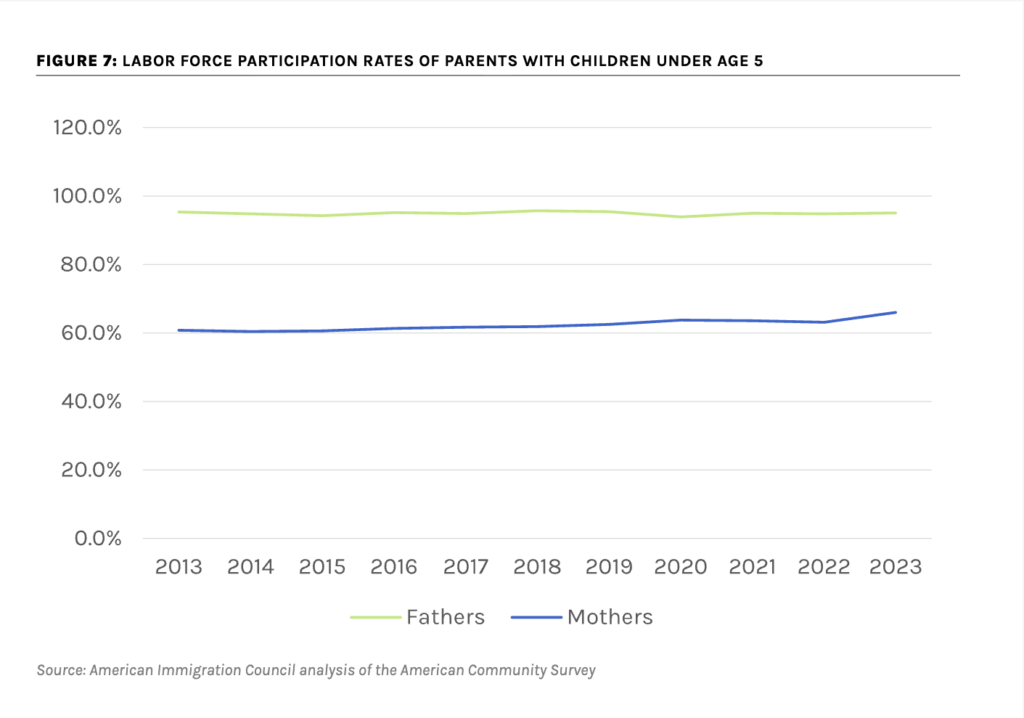
Among the 100 largest metropolitan areas in the United States, several in Texas have some of the lowest labor force participation rates among parents of children under the age of 5, such as El Paso (73 percent) and McAllen (73.9 percent). The rates were lower than the statewide rate of 79.4 percent or the national rate of 81.8 percent.
Of the children in Texas who are under age 5, 1.1 million, or 56.2 percent, live in households without a stay-at-home parent, indicating a strong demand for childcare support.
Immigrant Childcare Workforce
In Texas, 22,900 immigrants worked in the childcare sector, making up 19.2 percent of the state’s childcare workforce. In the Houston metro area, 30.8 percent of all childcare workers were immigrants, while in the Dallas metro area, 19.7 percent were immigrants.
About 18,900 immigrants provide center-based or home-based childcare services in Texas, representing 18.0 percent of the workforce. Meanwhile, immigrants make up 28.7 percent of childcare providers working in private households.
Immigrant childcare workers were also more likely to be self-employed than their U.S.-born counterparts, either starting their own childcare business, and sometimes hiring employees, or contracting their childcare services directly to families. In Texas, 20.9 percent of immigrant childcare workers were self-employed in 2023, compared with 16.5 percent of U.S.-born childcare workers.
Immigrants were also more likely to work full-time in the childcare sector. Nearly 71 percent of immigrants in the childcare sector worked at least 35 hours a week, compared with 60.7 percent of U.S.-born childcare workers.
Caring for Children from Kabul to Houston
Safia is among the 50,500 Afghan refugees admitted to the United States via the Special Immigrant Visa (SIV), a program created by Congress to help Afghans who worked for the U.S. government abroad. A college-educated math teacher who is not yet licensed to teach in the United States, Safia applied for a childcare training and licensing class at ECDC – Houston Multicultural Center. “In order to speed up this self-sufficiency goal, it takes everyone in the household working,” said Earlene Leverett, the program’s former manager. Additionally, “Employers are finally realizing the impact that childcare has on the economy. Businesses have jobs, they need employees to fill those jobs, those employees need childcare.”
Read the StoryDemographic Profile of Immigrant Childcare Workers
Immigrant women played a significant role in in the state’s childcare workforce. About 22,500 immigrant women worked in childcare in Texas, comprising 98.3 percent of all immigrant childcare workers and 18.9 percent of childcare workers from all backgrounds.
A higher share of the immigrant childcare workers, 79.2 percent, fell into the age group of 25 to 64, compared with 64.3 percent for their U.S.-born counterparts. Meanwhile, nearly one in three U.S.-born childcare workers, 32 percent, were between the ages of 16 to 24, compared with 11 percent of immigrant workers.
Immigrant childcare workers are also more likely to sit at both ends of the educational spectrum—to either lack a high school diploma or have a college degree—than their U.S.-born counterparts. Less than half have graduated high school but not finished college, compared with three-quarters of U.S.-born childcare workers who are in that position.
Figure 8: Educational Attainment of Childcare Workers in Texas, 2023
| Education Level | Share of Immigrant Childcare Workers | Share of U.S.-Born Childcare Workers |
|---|---|---|
| Below high school diploma | 19.6% | 5.3% |
| High school or some college | 49.5% | 75.9% |
| Bachelor’s degree or advanced degree | 31.0% | 18.8% |
Hispanics made up nearly two-thirds (63.2 percent) of immigrant childcare workers in Texas, followed by Asian and Pacific Islanders (17.7 percent) and non-Hispanic Whites (12.1 percent). More than one-third (38.9 percent) came from Mexico.
Many immigrant childcare workers are longtime residents of the United States: 81 percent have been in the country for more than five years. More than 41 percent of immigrant childcare workers have become naturalized citizens.
Conclusion
Immigrants, especially immigrant women, are critical to ensuring that Texas families have access to the childcare they need. Indiscriminate immigration enforcement tactics, including community raids and fear-inducing anti-immigrant rhetoric, have prevented many immigrants from living and working in the United States. But in doing so, such actions will ultimately hurt Texas families and Texas businesses. Without the outsized support of immigrants in childcare, many parents without affordable childcare alternatives will be forced to reduce the number of hours they work or leave the workforce altogether—a blow to the financial wellbeing of their families, to the bottom line of businesses, which depend on a strong, reliable workforce, and to the region’s economic vitality.
- Unless otherwise noted, data comes from the American Immigration Council analysis of the American Community Survey. Steven Ruggles, Sarah Flood, Matthew Sobek, Daniel Backman, Grace Cooper, Julia A. Rivera Drew, Stephanie Richards, Renae Rodgers, Jonathan Schroeder, and Kari C.W. Williams, IPUMS USA: Version 16.0 [dataset], Minneapolis, MN: IPUMS, 2025, https://doi.org/10.18128/D010.V16.0. ↩︎
- Child Care Aware of America, Demanding Change: Repairing Our Child Care System, Fall 2022, https://info.childcareaware.org/hubfs/2022-03-FallReport-FINAL%20(1).pdf. ↩︎
- Elizabeth Cummins Muñoz, interview with author, September 22, 2025. ↩︎
- Muñoz, interview. ↩︎
- U.S. Department of Labor, “NEW DATA: Childcare Costs Remain an Almost Prohibitive Expense,” November 19, 2024, https://blog.dol.gov/2024/11/19/new-data-childcare-costs-remain-an-almost-prohibitive-expense. ↩︎
- U.S. Census Bureau, “Nearly Half of Renter Households Are Cost-Burdened, Proportions Differ by Race,” Newsroom: Press Releases, September 12, 2024, https://www.census.gov/newsroom/press-releases/2024/renter-households-cost-burdened-race.html. ↩︎
- U.S. Department of Labor, Women’s Bureau, Childcare Prices as a Share of Median Family Income by Age of Children and Care Setting, 2022 (CSV dataset), 2024, accessed October 13, 2025, https://www.dol.gov/ agencies/wb/topics/featured-childcare. ↩︎
- U.S. Department of Health and Human Services, “Improving Child Care Access, Affordability, and Stability in the Child Care and Development Fund (CCDF),” Federal Register, 89 FR 15366, March 1, 2024, https://www.federalregister.gov/documents/2024/03/01/2024-04139/improving-child-care-access-affordability-and-stability-in-the-child-care-and-development-fund-ccdf. ↩︎
- Child and Adolescent Health Measurement Initiative, National Survey of Children’s Health: Interactive Data Query, Data Resource Center for Child and Adolescent Health, supported by the U.S. Department of Health and Human Services, Health Resources and Services Administration, Maternal and Child Health Bureau, retrieved October 22, 2025, https://www.childhealthdata.org/browse/survey/results?q=11737&r=1. ↩︎
- “Jen,” interview with author, October 16, 2025. A pseudonym was used to protect the subject’s identity. ↩︎
- American Immigration Council analysis of the Current Population Survey, Basic Monthly Survey (BMS) Combined dataset. Sarah Flood, Miriam King, Renae Rodgers, Steven Ruggles, J. Robert Warren, Daniel Backman, Etienne Breton, Grace Cooper, Julia A. Rivera Drew, Stephanie Richards, David Van Riper, and Kari C.W. Williams, IPUMS CPS: Version 13.0 [dataset], Minneapolis, MN: IPUMS, 2025, https://doi.org/10.18128/D030.V13.0. ↩︎
- American Immigration Council analysis of the Current Population Survey, Annual Social and Economic Supplement (ASEC) Combined Dataset. Sarah Flood, Miriam King, Renae Rodgers, Steven Ruggles, J. Robert Warren, Daniel Backman, Etienne Breton, Grace Cooper, Julia A. Rivera Drew, Stephanie Richards, David Van Riper, and Kari C.W. Williams, IPUMS CPS: Version 13.0 [dataset], Minneapolis, MN: IPUMS, 2025, https://doi.org/10.18128/ D030.V13.0. ↩︎
- American Immigration Council analysis of the Current Population Survey, Annual Social and Economic Supplement (ASEC) Combined Dataset, Flood et al., IPUMS CPS. ↩︎
- U.S. Bureau of Labor Statistics, Occupational Outlook Handbook: “Childcare Workers,” accessed October 13, 2025, https://www.bls.gov/ooh/personal-care-and-service/childcare-workers.htm#tab-6. ↩︎
- Ruth Jennifer Cruz, interview with author, September 22, 2025. ↩︎
- Maria Rojas, interview with author, October 9, 2025. ↩︎
- Silvia Muñoz and Caitlin McLean, Immigration Policies Harm the Early Childhood Workforce and the Communities They Serve, Center for the Study of Child Care Employment, University of California, Berkeley, April 22, 2025, https://cscce.berkeley.edu/publications/brief/ immigration-policies-harm-ece/. ↩︎
- Sara Tenenbaum, “ICE Agents Detain Teacher at Chicago Preschool and Daycare in North Center,” CBS News Chicago, updated November 5, 2025, https://www. cbsnews.com/chicago/news/federal-agents-chicago-daycare-preschool-teacher-detained/. ↩︎
- Kristina Cooke and Ted Hesson, “Thousands of Agents Diverted for Trump Immigration Crackdown,” Reuters, March 22, 2025, https://www.reuters.com/world/ us/thousands-agents-diverted-trump-immigration-crackdown-2025-03-22/. ↩︎
- Chabeli Carrazana, “Child Care Workers in D.C. Go Underground Amid ICE Crackdown,” The 19th, September 11, 2025, https://19thnews.org/2025/09/ child-care-workers-ice-dc-immigration/. ↩︎
- United States Conference of Catholic Bishops, Immigration enforcement and protected areas, 2025, January 22, 2025, https://www.usccb.org/resources/ protectedareas.pdf. ↩︎
- Chabeli Carrazana, “Child Care Workers in D.C. Go Underground Amid ICE Crackdown,” The 19th, September 11, 2025, https://19thnews.org/2025/09/child-care-workers-ice-dc-immigration/. ↩︎
- Sarah Butrymowicz, “1 in 5 Child Care Workers Is an Immigrant. Trump’s Deportations and Raids Have Many Terrified,” The Hechinger Report, February 27, 2017, https:// hechingerreport.org/1-in-5-child-care-workers-is-an-immigrant-trumps-deportations-and-raids-have-many-terrified/. ↩︎
- Maya Lora, “ICE May Show Up at Your Day Care. This is How Your Teachers Are Preparing,” The Baltimore Banner, accessed November 6, 2025, https://www.thebanner. com/education/early-childhood/ice-maryland-day-care-UM7BLMLWWJBUDGARQN7BALTTQI/. ↩︎
- Dara Lind, “Trump Administration Terminates CHNV Program, Impacting More Than a Half-Million Immigrants,” American Immigration Council, April 8, 2025, https:// www.americanimmigrationcouncil.org/blog/trump-terminates-chnv-program-impacting-more-than-half-million-immigrants/. ↩︎
- Andrew Kreighbaum, “Au Pairs, Summer Workers Ensnared in Trump Visa Interview Freeze,” Bloomberg Law, June 17, 2025, https://news.bloomberglaw.com/daily-labor-report/ au-pairs-summer-workers-ensnared-in-trump-visa-interview-freeze. ↩︎
- U.S. Department of State, Exchange Visitor Program—Au Pairs: Notice of Proposed Rulemaking, Federal Register, 88(208), 74071–74085, October 30, 2023, https://www. federalregister.gov/documents/2023/10/30/2023-23650/ exchange-visitor-program-au-pairs. ↩︎
- U.S. Department of State, Participant and Sponsor Totals 2022, BridgeUSA, Bureau of Educational and Cultural Affairs, 2022, https://j1visa.state.gov/basics/facts-and-figures/ participant-and-sponsor-totals-2022/. ↩︎
- Eileen Huck, interview with author, September 10, 2025. ↩︎
- Umair Ali, Jessica H. Brown, and Chris M. Herbst, Secure Communities as Immigration Enforcement: How Secure Is the Child Care Market? IZA Discussion Paper No. 15821, Institute of Labor Economics, December 2022, 29, https:// docs.iza.org/dp15821.pdf. ↩︎
- Ali, Brown, and Herbst, Secure Communities as Immigration Enforcement. ↩︎
- Chloe N. East and Andrea Velásquez, Unintended Consequences of Immigration Enforcement: Household Services and High-Educated Mothers’ Work (draft, University of Colorado Denver, 2022), 3, https://www.andreapvelasquez.com/uploads/1/2/2/1/122112301/ draft.pdf. ↩︎
- East and Velásquez, Unintended Consequences of Immigration Enforcement, 3. ↩︎
- Maki Park and Jazmin Flores Peña, The Invisible Work of Family, Friend, and Neighbor Caregivers and Its Importance for Immigrant and Dual Language Learner Families, Migration Policy Institute, December 2021, https://www.migrationpolicy.org/sites/default/ files/publications/nciip-ffn-care-brief_final.pdf. ↩︎
- American Immigration Council, Immigrants in the United States, https://map. americanimmigrationcouncil.org/locations/national#topIndustries. ↩︎
- American Civil Liberties Union, Freezing Out Justice: How Immigration Arrests at Courthouses Are Undermining the Justice System, May 3, 2018, https:// assets.aclu.org/live/uploads/publications/rep18-icecourthouse-combined-rel01.pdf. ↩︎
- Damaris Alvarado-Rodriguez, interview with author, October 10, 2025. ↩︎