Restrictionists
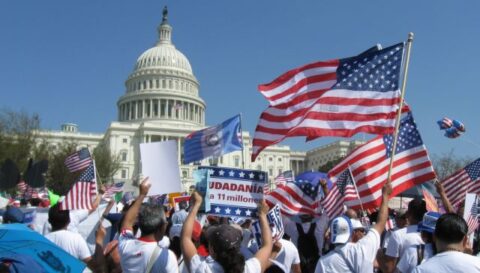
The Charismatic Leaders Behind Immigration Reform
The tens of thousands of people who gathered Wednesday in front of the Capitol to rally for comprehensive immigration reform had two clear messages for Congress: reform must include a direct path to citizenship for the 11 million undocumented immigrants currently living in the United States, and “The Time Is Now.” Read More

Nativist Group Releases Confusing Report on Legalization
The work of the nativist Center for Immigration Studies (CIS) is focused on grinding an anti-immigrant ideological axe, not on gathering evidence and employing rigorous analysis. A case in point is CIS’s recent report on the hypothetical cost of processing an “amnesty application.” It is difficult to discern what the point of the report actually is. It would seem to be that unauthorized immigrants are bad for the U.S. economy (which is false), and that legalizing them would offer no benefits for the U.S. economy (which is also false), so there shouldn’t be a new legalization program, but if there is going to be a new legalization program, it should be so expensive that lots of unauthorized immigrants can’t afford it, which would presumably leave a large unauthorized population in the United States, which would presumably still be bad for the U.S. economy. Needless to say, this is a rather convoluted analysis. Read More

Pro-Immigrant Measures Make Gains At The State Level
As we reach the midpoint in state legislative sessions, 2013 is shaping up to be a year where most states are moving in a more positive direction when it comes to immigration policy. Lawmakers from both parties have become more inclined to support pro-immigrant measures, shifting away from the anti-immigrant policies that swept across states in previous years. Read More

U.S. Border-Enforcement Programs Target Immigrants Who Aren’t a Threat to Anyone
Since the Department of Homeland Security (DHS) was created in 2003, its immigration-enforcement agencies—Customs and Border Protection (CBP) and Immigration and Customs Enforcement (ICE)—have been officially devoted to the protection of U.S. national security and the prevention of terrorist attacks. However, the bulk of the work done by CBP and ICE on a day-to-day basis involves apprehending and deporting non-violent immigrants who have only committed immigration offenses such as unlawful entry or re-entry into the United States. The highly punitive treatment of these immigration offenders serves no national-security purpose and is not an effective deterrent. Read More

Congressional Hearing Illustrates Nativist Manipulation of “Border Security”
The concept of “border security” is inherently ambiguous. After all, we live in a world where no international border can be completely sealed. The risk that a bad guy will come across the border—by land, sea, or air—can never be reduced to zero, no matter how much money or manpower is funneled into border-security operations. As a result, it is easy for political opportunists to use the notion of “border security” as a smoke screen behind which to advance their own agendas. In the context of the debate over immigration reform, the quest for ever-increasing levels of border security is used as an excuse to oppose any meaningful changes to a dysfunctional immigration system which itself undermines security by its failure to operate fairly or efficiently. This is an irony which is apparently lost on those nativist politicians and activists for whom no level of border enforcement will ever be viewed as sufficient to justify immigration reform. Read More
Nativists Fail to Grasp Economics of Immigration Reform
This week, the New York Times gave voice to the nativist argument that legalizing unauthorized immigrants would drain the federal budget because newly legalized immigrants will start using public benefits. However, this flawed fiscal accounting overlooks the myriad ways in which immigrants, just like the native-born, contribute to the U.S. economy over the course of their adult lives. As workers, they add value to the economy through their labor. As taxpayers, they fund government services and programs at the federal, state, and local levels. As consumers, immigrants purchase goods and services from U.S. companies, big and small, sustaining U.S. jobs in the process. And, as entrepreneurs, many immigrants create jobs through the businesses they establish. In other words, the economic contributions of any person, immigrant or native-born, come in many forms and span a lifetime. Read More

Politicians Invent Doomsday Predictions About Immigration Reform
Nativists are rarely encumbered by facts. By its very nature, nativist rhetoric is based on stereotype and mythology, not empirical evidence. Regrettably, some of our elected leaders in the House of Representatives and the Senate have embraced the mirage of nativism as they embark on a crusade to derail any meaningful reform of the U.S. immigration system. More precisely, anti-reform politicians have been issuing doomsday predictions about what will happen to the nation if a legalization program is created for unauthorized immigrants already living in the United States. It comes as little surprise that these predictions have no basis in reality. Read More

Why Should We Support a Legalization Program for Unauthorized Immigrants?
As the immigration debate heats up in Congress, the central question for much of the American public will be whether or not to create a pathway to legal status for the 11 million unauthorized immigrants now living in the United States. In formulating an answer to that question, however, it is necessary to ask two others. First, exactly who are the unauthorized immigrants who would be attaining legal status? Secondly, what would the impact be on the U.S. economy were so many unauthorized immigrants to be legalized? The answer to the first question is relatively simple: unauthorized immigrants are just like everybody else; they are adults and children, mothers and fathers, homeowners and churchgoers. The short answer to the second question is that legalization would be a stimulus to the U.S. economy. Workers with legal status earn higher wages, and these extra earnings generate more tax revenue for federal, state, and local governments, as well as more consumer spending, which sustains more jobs in U.S. businesses. Read More

Federal Judge Leaves Anti-DACA Lawsuit Hanging By a Thread
Lost amidst coverage of recent immigration reform proposals was a ruling issued last Friday in Kris Kobach’s legal crusade against the Deferred Action for Childhood Arrivals (DACA) program. The lawsuit, filed last summer in a federal court in Dallas, alleges the program violates an obscure provision of the immigration laws that supposedly prohibits immigrants who entered the country unlawfully from receiving deferred action. Although the ruling in question allowed the case to move forward, the presiding judge rejected the vast majority of Kobach’s arguments and left the suit hanging by a thin legal thread. Read More

Getting to a Citizenship Consensus
Immigration reform is enjoying a resurgence of support in both parties, with groups from a variety of backgrounds coming out in favor of a range of changes to our current system. The most striking change may be the melting of opposition to a pathway to citizenship for the 11 million undocumented immigrants in the U.S. But acceding to citizenship and creating a system that will actually allow people to get there are two different things. Read More
Your support moves the American story toward justice, dignity, and belonging.
America's story is an immigrant story.