The American Immigration Council is a non-profit, non-partisan organization.
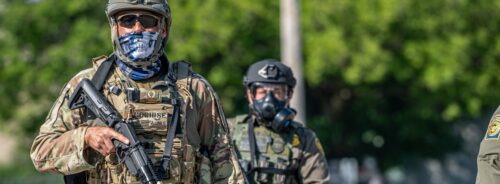
 When Border Patrol agents descended upon Charlotte, North Carolina last week, many wondered why they were allowed to stop and question people so far from the border. Typically, it’s U.S. Immigration and Customs Enforcement (ICE) agents who have become ubiquitous with the largescale enforcement operations of the second Trump presidency, seen roaming the streets of places like Chicago and Los Angeles.
Charlotte is over 150 miles from the coastal border, over 500 miles from the Canadian border, and over 1,200 miles from the Mexican border. So why, then, were Border Patrol agents—mostly known for their operations along the U.S.-Mexico border—arresting people deep in the interior of the country?
The short answer: legally, Border Patrol has more authority than most people realize—and politically, the Trump administration is leveraging every ounce of that authority.
What the 100-mile zone does (and doesn’t) mean
A key source of confusion is the so-called “100-mile zone.” Under Section 287 of the Immigration and Nationality Act (INA), immigration enforcement officers—including both ICE and Border Patrol—can “board and search for” unauthorized immigrants on vessels, trains, aircraft, or vehicles located “within a reasonable distance from any external boundary of the United States.”
Federal regulations define that “reasonable distance” to generally be within 100 miles of land and coastal borders. (Airports are not covered in the 100-mile zone, as they serve as ports of entry for international travelers.)
The 100-mile zone limits Border Patrol’s authority to a certain extent: they cannot board buses or trains outside the zone, nor can they set up fixed vehicle checkpoints. It is, however, within their power to pull a driver over and interrogate them about their immigration status if they have “reasonable suspicion” that they are not a citizen.
Border Patrol vs. ICE: Why the distinction is blurring
The INA defines agents from both Border Patrol and ICE as “immigration officers,” meaning they share a set of nationwide enforcement authorities, including:
- The power to interrogate any person they believe may be an immigrant about their right to be in the United States.
- The power to make warrantless arrests if an individual is believed to be violating immigration law and likely to flee before a warrant can be obtained.
- The power to make arrests for immigration-related felonies and, in some cases, other federal crimes committed in their presence.
These authorities apply anywhere in the country, not just near the border.
Roving patrols
Historically, Border Patrol agents would only conduct these vehicle searches near the border to prevent illegal entry into the United States. Now, they’re being used by immigration agents far from the border, on the mere suspicion that someone “looks” undocumented. The Trump administration has taken this authority to the extreme, sending Border Patrol and ICE “roving patrols” to terrorize communities.
The Supreme Court intervened to let the controversial tactic continue. A majority of the justices paused, without any explanation, a ruling that masked and armed agents could not snatch people off the street and question them based on their perceived race, what language they speak, what they do for work, and even where they happen to be when they encounter an immigration agent. Both a federal district court in Los Angeles and the 9th Circuit Court of Appeals had previously ruled that these actions amounted to illegal racial profiling.
In a concurrence, Justice Kavanaugh argued that these stops were not a significant problem for citizens and lawfully present immigrants, based on his belief that individuals could show ID and be permitted to go immediately. However, in many cases, this has proven to be false, as Department of Homeland Security officers have detained U.S. citizens and lawfully present immigrants for hours, or days, while their paperwork was checked. While the case will likely eventually reach the Supreme Court again, for now, the case has weakened one method courts had to limit the actions of these roving patrols.
Border Patrol: A history of violence and immunity
Under President Trump’s mass deportation agenda, every immigration officer counts—so both ICE and Border Patrol are pulled into interior operations that would have previously been handled by ICE alone.
Border Patrol is not only legally able to participate, they’re well-practiced in aggressive enforcement tactics developed in border communities where they have enjoyed heightened authority for over a century.
Since its creation in 1924, the Border Patrol agents have stereotyped and dehumanized the targets of enforcement actions. The agency reveals little to the public or Congress about how it operates and largely gives its officers autonomy in the field. Border Patrol agents are rarely disciplined for misconduct, even when it results in death. Despite this lack of transparency and accountability, the budget, workforce, and arsenal of the agency have grown significantly over the decades; a growth which has been supercharged by the One Big Beautiful Bill Act of 2025.
Taken together, this means that what border communities have endured for generations is no longer confined to the 100-mile zone. The legal framework that once provided Border Patrol with its powers at the border is now being stretched across the entire country.
As a result, communities like Charlotte, Chicago, Los Angeles, and Atlanta are now experiencing the consequences of an enforcement model built for a militarized border, with more cities likely soon to follow.