 The American Immigration Council is a non-profit, non-partisan organization.
 After more than 100 games across 16 host cities and countless memorable moments, the 2026 FIFA World Cup ends on July 19 with Spain and Argentina meeting in the final. In the lead up to the tournament, the Trump administration’s immigration policies gave cause for real concern: travel bans, visa bond requirements, and the specter of immigration enforcement have all had an impact on players (like those from Iran), coaches, officials, and fans alike.
But once the tournament kicked off in mid-June, the World Cup on U.S. soil did what it meant to do: it created an opportunity for cultural exchange and shared joy beyond borders.
American communities welcome the world
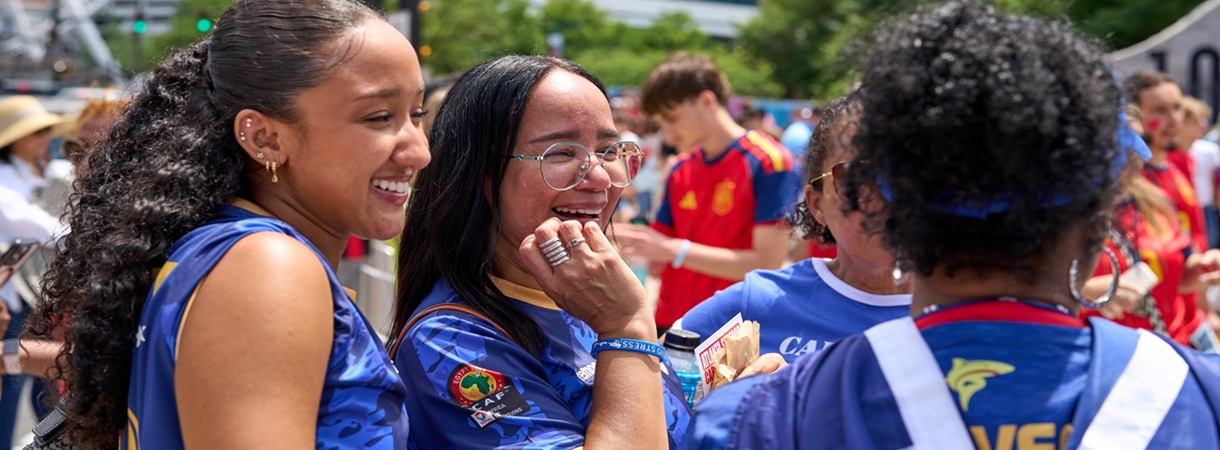
In communities across the country, from small towns to big cities, everyday Americans participated in the spectacle and tradition of this World Cup. Host communities went above and beyond to welcome international teams and fans.
In one of the more unexpected moments of togetherness, residents of Lawerence, Kansas, stepped up to welcome the Algerian national team to their city. A viral video of an elderly man overjoyed with the team’s presence kicked off the story. The fact that the Algerian team chose Lawrence as their home base for the tournament was a source of pride for residents.
Elsewhere in Kansas, in Overland Park, the Kansas City World Cup host committee set up a Consular Services Center to provide diplomatic and citizen support services during the tournament for some traveling fans, including emergency passport and travel document assistance. With many international travelers in the region for the first time, services like this go a long way in putting fans’ minds at ease.
Africatown in Philadelphia, the neighborhood where the city’s largest African diaspora lives, welcomed swaths of fans from Ghana, Côte d’Ivoire, Curaçao, and Haiti. The city coordinated watch parties, fan festivals, and more, to highlight the area’s rich history and culture and invite newcomers in.
Haitian fans brought joy to the streets of Boston, when hundreds marched in the Haiti Fan Walk after qualifying for the World Cup for the first time since 1974. Despite travel restrictions preventing most Haitians from traveling to the United States from the island, many Haitians from Boston and across the U.S. brought the excitement and hopes of their home nation with them. Boston Mayor Michelle Wu said, “The Boston Haitian community is one of the largest anywhere in the world. Definitely the strongest.”
Fans from Scotland also brought World Cup fever to Boston, with their effervescent celebrations capturing the attention of the entire city. In fact, to commemorate the friendship between the Scottish fans (knows as the “Tartan Army”) and the Boston community, city and state officials formally welcomed the Glasgow Traffic Cone — a decades-old tradition in Scotland — to Massachusetts.
The Norwegian team and their fans captured the hearts and minds of fans on and off the field with their iconic “Viking row” celebration that many non-Norwegians joined in on too. Perhaps the team’s biggest fans outside of Norway were in the town of Greensboro, North Carolina. The Norway team chose to set up their training camp there, and the locals welcomed them fervently, with thousands attending their open practice and Norway jerseys adorning sports bars in the city.
With countless examples of cross-cultural celebration in the United States, American communities came together with people from other nationalities for a moment of shared jubilation.
What comes next?
This World Cup was an important reminder that welcoming is a core American value. When given the chance, American communities will embrace visitors from across the globe, share our customs, and partake in those from other countries.
This stands in contrast to the federal immigration policies advanced by the Trump administration. The enduring travel ban, recent Supreme Court decision to end Temporary Protected Status (TPS) for several countries, and the violence perpetrated by U.S. Immigration and Customs Enforcement (ICE) all go against the values Americans demonstrated during the World Cup.
With the 2028 Los Angeles Olympic Games on the horizon, there is much work to do to make sure that our immigration policies and rhetoric better reflect the inclusivity on display across the country during the 2026 World Cup.