 The American Immigration Council is a non-profit, non-partisan organization.
 For years, the federal government had one, clear message for migrants seeking asylum at the U.S.-Mexico border: go to a port of entry and do not cross the border illegally.
This message was bipartisan. Former Secretary of Homeland Security Kirstjen Nielsen declared in June 2018: “If you are seeking asylum, go to a port of entry. You do not need to break the law of the United States to seek asylum.” President Trump echoed that message, telling reporters, “If you go to a port of entry, it works out very nicely … That’s called ‘doing it the legal way.’” This message was backed up with policy; both Trump and Biden moved to ban asylum to anyone who chose not to “go to a port of entry” (even though U.S. asylum law permits people who enter at other locations to apply for asylum).
Despite this, since 2016, starting the asylum process at southern border ports of entry has been difficult, and at times impossible. For many migrants over the last decade, physically “going to a port of entry” often accomplished nothing. Since 2016, officials from U.S. Customs and Border Protection (CBP) have at times blocked at ports of entry, most often through a practice they called “metering,” in which customs officers would stand at the border line and physically block arriving migrants from stepping onto U.S. soil. The result of this was often chaos, with migrants turned back to danger and corrupt actors south of the border profiting from CBP’s refusals.
In the face of metering, the American Immigration Council, along with our partners, filed a lawsuit in 2017 seeking to hold the government to its promise and to the law, and let people “do it the legal way.” We argued that when CBP officers told migrants standing just inches from the border line to go away, they were violating the law, both because customs officers must “inspect” any person who is “seeking admission” or who “arrives in” the United States, and because asylum law declares that any person “physically present in” or who “arrives in” the United States may apply for asylum.
Last week, despite our victories in the lower courts, the Supreme Court ruled against us, holding that a person inches from the border whom CBP officers block from accessing a port of entry is not someone who “arrives in” the United States — and therefore, CBP officers have no obligation to inspect them, nor does the person have a right to access the asylum process. If a migrant walks up to the physical border and says, “I want to seek asylum” to a customs official standing on U.S. soil, the official has no obligation to do anything and indeed may simply tell the person to go away.
Despite this bizarre ruling, a new piece from Blas Nuñez-Neto and Daniel Delgado, former senior officials at DHS during both the Biden and Obama administrations, embraces this result. They argue that “metering is good border policy,” and cheer on the Supreme Court’s decision. Unfortunately, their arguments miss the mark.
Metering is poor government policy that undermines orderly processing
First, Nuñez-Neto and Delgado incorrectly paint metering as a general good-government policy that was necessary to ensure orderly border operations. But this ignores the reality of metering; how it operated after it was first created in 2016 and the ways in which it distorted orderly operation at ports of entry and undermined the rule of law.
When “metering” was in effect, CBP artificially limited the number of people permitted to seek asylum at southern border ports of entry. At its most basic, metering entailed CBP officers telling migrants: “we’re closed today, go away.” At its most complex, metering entailed requiring migrants to register for an often-informal waiting list run by private or Mexican government actors in northern Mexico, with migrants waiting for their number to be called for weeks or months. They waited in squalid conditions at shelters, in makeshift camps, or on the streets in Mexican border towns. While there, they were often subjected to horrific abuses — rape, torture, and extortion by cartels.
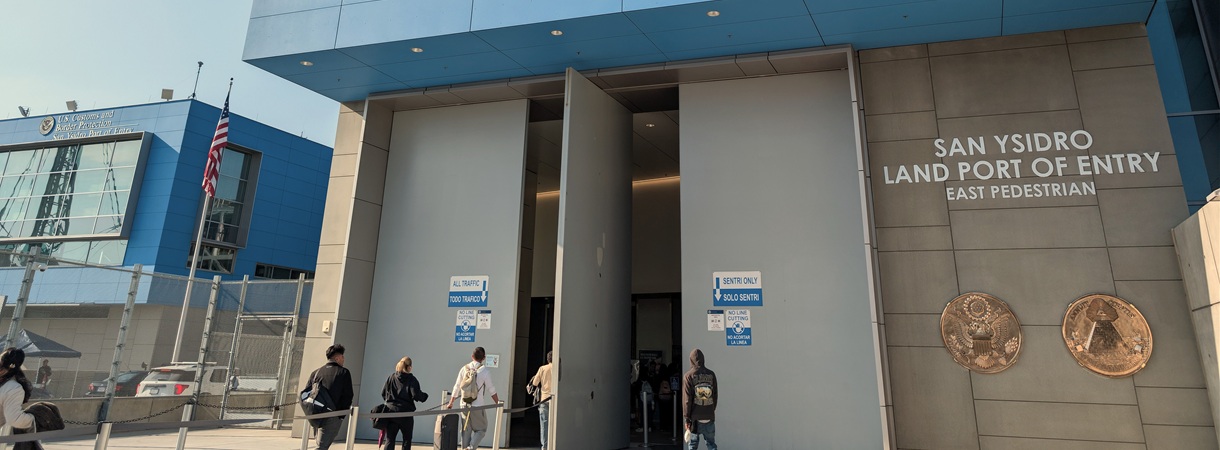
Ever since the Refugee Act was put into place in 1980, when a person approaches a border official and says they’re here to seek asylum, the border officer is supposed to take that person into custody and give them access to the asylum system, which adjudicates their claim. And that process is supposed to be the same no matter where it happens, either at an airport, a dock, or in the pedestrian lane of the San Ysidro port of entry where Americans are heading south to party (or go to the dentist) in Tijuana and Mexicans are heading north to shop at Walmart. But when metering was in effect, when migrants walked up to ports of entry, many found themselves turned away entirely and told to go back to Mexico and wait; try again another day, maybe never.
Metering first began in mid-2016 and stayed in effect through early 2017 at the San Ysidro port of entry south of San Diego (and briefly border-wide). In its initial incarnation, the United States outsourced who it would permit to enter each day to Mexican immigration personnel. Migrants were turned away and told to go to the offices of Mexican immigration agents, where they would have to get a ticket. Mexican officials would decide which ticket-holders it would take to the U.S. border each day, and only those people would be processed; all others would be turned away.
From 2018 through the outbreak of the COVID pandemic (which shut down access to asylum entirely), the ability of people to “go to a port of entry” became dramatically inconsistent across the border. In Tijuana, rather than tickets issued by Mexican immigration agents, migrants themselves operated a line system through a series of “lists” contained in physical notebooks. In Ciudad Juárez, local Mexican government officials ran the list.
Elsewhere, private or religious shelters ran lists. At some smaller ports of entry, no lists existed at all. Customs officers told migrants that seeking asylum was impossible there and that they would have to go away and try somewhere else. These lists often excluded vulnerable populations and at times were operated corruptly. While CBP engaged with the managers of each list, it disclaimed any responsibility for operating them.
Crucially, CBP’s claims of capacity issues were often false. In 2020, DHS’ Office of Inspector General (OIG) investigated the practice of metering. What they found was that when DHS Secretary Nielsen was publicly telling migrants to go ports of entry, she had secretly instructed those same ports of entry to deprioritize asylum processing. CBP openly lied about their capacity, telling migrants and the media that they had to turn people away because they were overwhelmed; even when cells were empty and officers were available.
By glossing over this history, Nuñez-Neto and Delgado disregard this capricious reality of metering.
The U.S. government can still manage the border without metering
Second, Nuñez Neto and Delgado are incorrect to suggest that the plaintiffs were trying to micromanage CBP operations, such that if the Supreme Court had reached the opposite conclusion, then “CBP would have no recourse at the land border to manage our ports of entry during times of crisis at the border.”
This is not true. The Ninth Circuit took pains to “stress that our decision leaves the Government with wide latitude and flexibility to carry out its duties at the border.” But it said that officials could not do what metering had often looked like; pure “turn-backs,” where U.S. government officials would just tell a migrant to go away, refuse to do anything, and limit the number of people they would let seek asylum to a handful of people each day.
Nuñez-Neto and Delgado declare that the Supreme Court’s decision upheld “the government’s right to manage its borders using tools that promote orderly processes,” but metering often had no orderly process; it was simply a low-level bureaucrat standing at the border line and telling a migrant to leave. Indeed, as the Biden administration showed, other methods of queue management can be put into place without crude metering practices.
By failing to acknowledge that CBP officers are required to inspect people who present themselves at the border, the Supreme Court has done the opposite of promoting an orderly process. It may ultimately permit the denial of a process in its entirety.
Effective and efficient management of the border is not improved by a process which allows the federal government to shirk its duty and hand decisions about who can seek asylum to foreign governments and citizens. With its ruling, the Supreme Court isn’t ensuring that the border operates smoothly; it’s making these kinds of capricious actions more likely to occur in the future.
Metering heightened danger for migrants and created perverse incentives
Third, Nuñez-Neto and Delgado ignore the dangerous consequences of metering. In their view, this is a simple question: “Does our obligation to allow people to claim asylum at ports of entry outweigh the imperative to ensure that the type of lawful activities that fuel our economy and connect border communities are not disrupted?” But there are more considerations, including the safety of the people seeking asylum and the perverse incentives created by denying people the chance to seek asylum
When migrants were sent back to Mexico under metering, many of them ended up forced to remain in Mexican border towns for months on end, with no clear sense of when they would be able to “go to a port of entry,” if ever. This placed people in a dangerous limbo, as Mexico’s northern border is crawling with bad actors looking to take advantage of migrants. Over the last decade, it’s likely that tens of thousands of migrants have been preyed upon by cartels and other criminal actors after being turned away by a CBP officer.
Metering not only enriched cartels, but it also fueled corruption. In the first Trump administration, because CBP put the onus on Mexican government officials to manage the waitlist process, some Mexican border officials essentially began selling access to American ports of entry. Thus, rather than promote the rule of law, metering allowed criminals to extort a stream of cash from migrants who were trying to come to the United States without breaking any law but found themselves unable to do so.
Over a decade, hundreds of thousands of migrants did in fact wait for their turn, wanting to start their time in the United States the most lawful way possible. But many others found this option impossible, as their savings dwindled and their risk of facing violence rose. These people, turned away by U.S. border officials, joined the millions of people who instead crossed the border between ports of entry and turned themselves in to the U.S. Border Patrol in a practice more chaotic than anything occurring at ports of entry.
This side effect of metering is well-documented. In the same DHS report that determined that CBP was turning away migrants despite ample processing capacity, the Inspector General declared that “as the lines grew and asylum seekers were redirected to other ports, some undocumented aliens attempted to enter the United States illegally, exacerbating the very problem DHS sought to solve.”
Congress should fix asylum; but metering isn’t the right way forward
Taking this all together, Nuñez-Neto and Delgado’s stance in favor of metering falls apart. While there is no doubt that CBP needs to have the ability to manage its capacity during times of high arrivals, metering was not some neutral practice designed to promote efficiency; it was a deliberate tactic designed to stop migrants from doing the one thing that both Democrats and Republicans agreed they should do: go to ports of entry.
That said, Nuñez-Neto and Delgado are both undoubtedly correct when they say that Congress needs to make significant changes to the law and address our broken asylum system. To do that, we need to have real, flexible procedures to handle people who can only make it here by land. Should Congress take up asylum reform, it must ensure that CBP officers cannot re-adopt the same counterproductive and deceptive metering practices.
As a result, we strongly disagree that the Supreme Court’s recent decision is a victory for the rule of law; it’s a victory for arbitrary actions which have measurably undermined orderly process. And neither liberals nor conservatives should be cheering it on.